

You’ve just hit your stride on a high-volume run when the injection molder suddenly freezes, triggered by a “ghost” PLC communication error that shouldn’t exist. It’s not a broken belt or a seized motor; it’s an invisible electrical surge stealing your profit. Preventing downtime in plastics manufacturing has traditionally focused on grease and gears, but in 2026, the real battle for 99% uptime is fought in the control cabinet.
We understand the exhaustion of explaining another mid-cycle stoppage to management while scrap piles grow. You deserve a floor where “unexpected” isn’t part of the daily vocabulary. This guide reveals how to eliminate the mechanical and invisible electrical failures that cost you thousands in lost production hours. We’ll explore everything from protecting sensitive heating elements with the SineTamer LA Series to navigating the new ISO 17223:2026 standards, giving you a clear path to operational excellence and the professional recognition you’ve earned.
Key Takeaways
- Identify the “ghost” errors and PLC resets that traditional maintenance misses by understanding how invisible electrical surges disrupt your machine logic.
- Implement a proactive blueprint for preventing downtime in plastics manufacturing that shifts your operations from reactive firefighting to a state of calm, consistent reliability.
- Discover how the SineTamer LA Series acts as a seasoned protector for your equipment, shielding sensitive heating elements and electronics from catastrophic failure.
- Learn how to transform power quality into a strategic advantage that reduces scrap rates and secures your reputation for operational excellence.
Identifying the Hidden Triggers of Plastics Manufacturing Downtime
In the high-stakes world of injection moulding and extrusion, every second counts. You know the pressure of a 24/7 floor. When a screw snaps or a heater band fails, you can see the problem and fix it. But the most frustrating obstacles to preventing downtime in plastics manufacturing are the ones you can’t see. We call this “Electrical Downtime.” It’s the sudden, unexplained halt that leaves your team staring at a blank HMI screen while the resin cools and hardens inside the barrel.
This invisible disruption creates a unique kind of stress for plant managers. You’ve checked the mechanical components. You’ve verified the hydraulic pressure. Yet, the machine remains idle. While mechanical wear is a slow, visible decline, transient voltage is a silent strike that bypasses your standard maintenance checks. It’s exhausting to fight an enemy you can’t see, especially when your reputation for operational excellence is on the line.
The High Cost of PLC Glitches and Controller Resets
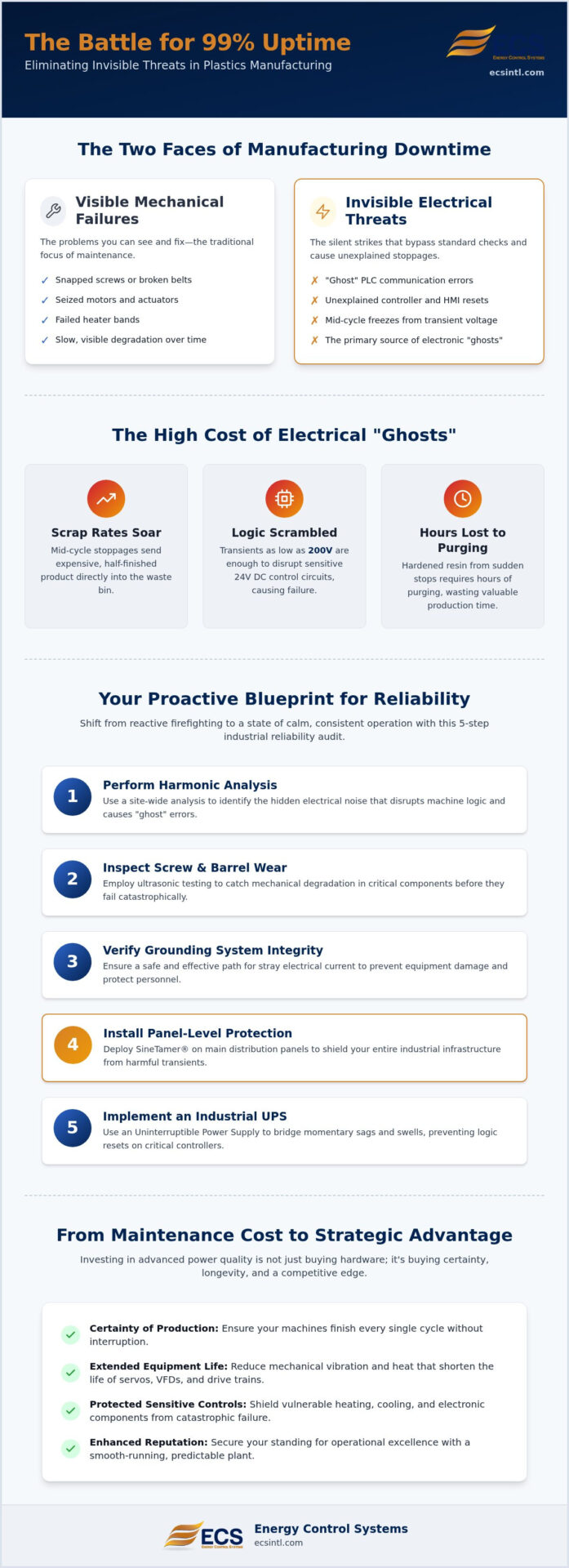
Modern plastics machinery relies on delicate 24V DC control circuits to manage complex logic. It doesn’t take a lightning strike to cause a failure; transients as low as 200V are enough to scramble these low-voltage signals. When this happens mid-cycle, the result is a catastrophic stoppage that sends scrap rates soaring. Transient voltage is the primary source of electronic “ghost” errors. These micro-interruptions force expensive resin into the waste bin and require hours of purging, proving that preventing downtime in plastics manufacturing requires more than just a wrench.
A Proactive Blueprint for Maximizing Injection Molding Uptime
Stop the cycle of firefighting. We know the exhaustion that comes with those 2 AM emergency calls when the floor goes dark. True stability comes from shifting your focus from the visible to the foundational. Preventing downtime in plastics manufacturing isn’t just about reacting to broken parts; it’s about building a permanent shield. By integrating surge protective devices, you address the root cause of many common causes of downtime before they ever reach your sensitive controllers.
Don’t let manual overrides or missing heater bands dictate your production schedule. Maintaining a robust inventory of thermocouples and providing rigorous operator training prevents the human errors that often compound technical issues. It’s time to restore your agency over the factory floor and achieve the professional recognition you deserve for a smooth-running plant.
5 Steps to an Industrial Reliability Audit
- Step 1: Perform a site-wide harmonic analysis to identify the hidden electrical noise that disrupts logic.
- Step 2: Inspect screw and barrel wear using ultrasonic testing to catch mechanical degradation early.
- Step 3: Verify the integrity of grounding systems to ensure a safe path for stray current.
- Step 4: Install SineTamer LA Series on main distribution panels to protect your entire industrial infrastructure.
- Step 5: Implement a UPS for industrial automation to bridge momentary sags and prevent logic resets.
Taking these deliberate steps transforms your operation from a state of constant anxiety to one of predictable calm. If you’re ready to secure your facility’s future, scheduling a professional harmonic analysis is the most effective way to start preventing downtime in plastics manufacturing today.
Securing Your Competitive Edge with Advanced Power Quality
Power quality is far more than a maintenance line item. It is a strategic advantage. In an industry where margins are tight and deadlines are unforgiving, the ability to maintain continuous production becomes your greatest weapon. When you invest in advanced protection, you aren’t just buying hardware. You’re buying the certainty that your machines will finish every cycle. Protecting your servos and Variable Frequency Drives (VFDs) does more than save circuit boards; it reduces the mechanical vibration and heat that shorten the life of your entire drive train.
Understanding the challenges and solutions in plastics manufacturing means recognizing that your precision heating and cooling controls are incredibly vulnerable. The SineTamer LA Series serves as the ultimate shield, neutralizing the electrical disturbances that standard equipment ignores. This is how you reclaim your time and restore personal agency over your production schedule.
The SineTamer Advantage for Precision Plastics Controls
Standard surge protection often fails because it only reacts to massive voltage spikes. SineTamer is different. Its Frequency Attenuation Network (FAN) actively monitors the power sine wave to filter out the low-level transients that confuse sensitive PID controllers. While the LA series guards the heavy machinery, the SineTamer RM Series provides specialized protection for the server rooms managing your critical ERP and SCADA data. This holistic approach is the foundation of preventing downtime in plastics manufacturing.
You deserve a facility that runs with quiet, predictable efficiency. We’re here to help you move past the chaos and into a state of operational excellence. You have the right to a stress-free environment where your expertise shines, unhindered by the “ghosts” of poor power quality.
Take Command of Your Factory Floor
You now understand that “ghost” errors and sudden PLC resets are often symptoms of electrical instability rather than simple mechanical wear. By shifting your focus to foundational power quality, you move from the exhaustion of constant firefighting to a state of predictable, profitable production. Preventing downtime in plastics manufacturing isn’t just a technical goal; it’s about reclaiming your personal agency and peace of mind. With over 35 years of experience, we’ve seen how the battle-tested SineTamer LA Series restores stability to even the most demanding environments.
Don’t let invisible transients continue to inflate your scrap rates and disrupt your schedule. Empower your plant with a Professional Power Quality Audit to identify hidden threats before they stop your floor. You’ve earned the right to a stress-free, high-performance facility, and we’re here to help you secure it.
Frequently Asked Questions
How do electrical transients specifically affect injection molding machines?
Electrical transients cause micro-interruptions in your machine’s logic, leading to unexpected cycle stops and “ghost” alarms. Beyond software glitches, these surges generate excess heat in heater bands and stress the insulation of drive motors. This degradation is often invisible until a total failure occurs. By addressing these transients, you’re protecting the long-term health of your entire mechanical system.
Can a UPS system prevent all types of downtime in plastics manufacturing?
A UPS is a vital tool for bridging momentary sags, but it isn’t a silver bullet for preventing downtime in plastics manufacturing. While it keeps controllers alive during a voltage drop, it doesn’t filter out high-frequency noise or transients that can still damage the equipment it powers. A complete reliability strategy requires combining surge protection with power conditioning for total stability.
Is harmonic distortion common in factories using variable frequency drives (VFDs)?
Harmonic distortion is nearly universal in modern plastics facilities because VFDs are non-linear loads. These drives draw current in pulses, which creates “dirty” power that can overheat transformers and cause premature failure in sensitive electronics. Identifying these hidden disturbances through professional harmonic analysis is essential. It’s the only way to restore order to your electrical environment and protect your professional reputation.
What is the difference between a standard surge protector and the SineTamer LA Series?
Standard protectors are like a fuse that only reacts to massive voltage spikes. In contrast, the SineTamer LA Series features a Frequency Attenuation Network that actively cleans the power sine wave. It targets the low-level transients that occur thousands of times a day. This specialized technology is a cornerstone for preventing downtime in plastics manufacturing, acting as a seasoned protector for your precision controllers.

Article by
Jeff Edwards
Founder of ECS International Inc. Edwards travels and speaks extensively in Latin America, Asia and Africa on the subject of power quality; transients and mitigating their impact on profitability. After graduating from Texas Tech University in Lubbock Texas, Edwards spent 9 years in the Telecommunications sector prior to founding Energy Control Systems in 1987 as a Texas based corporation selling surge suppression and UPS systems. The company has evolved into a global power quality products and energy efficiency concern with operations spanning South America, Asia, Europe and Africa.
Disclaimer
Some of the above information may be the opinion of the author.