

A single hour of unplanned downtime in a manufacturing plant now costs an average of $260,000. You’ve felt that heavy weight when a critical PLC fails at 2:00 AM, leaving you to face a frustrated board and a stalled line. It’s more than a repair bill; it’s a direct hit to your peace of mind. Calculating the cost of power surge damage requires looking beyond the visible wreckage to the “invisible tax” of internal transients that quietly erode your hardware every day.
You deserve to lead a facility defined by predictable stability. We’re here to help you move from reactive repairs to total operational calm. This guide provides the evidence you need to secure your budget and restore your personal agency. You’ll discover a clear formula for determining your true downtime loss and learn how professional-grade protection transforms your ROI into a certainty.
Key Takeaways
- Identify the “invisible tax” of internal transients that account for 80% of equipment degradation and silent system failures.
- Use our 5-step framework for calculating the cost of power surge damage to justify O&M expenses and secure budget for power quality upgrades.
- Understand the critical difference between basic voltage clamping and frequency attenuation to ensure your critical assets receive professional-grade protection.
- Transition from the chaos of midnight breakdown calls to a state of calm, restoring your personal agency and professional status within your organization.
The Hidden Math: Why Surge Damage is More Than a Repair Bill
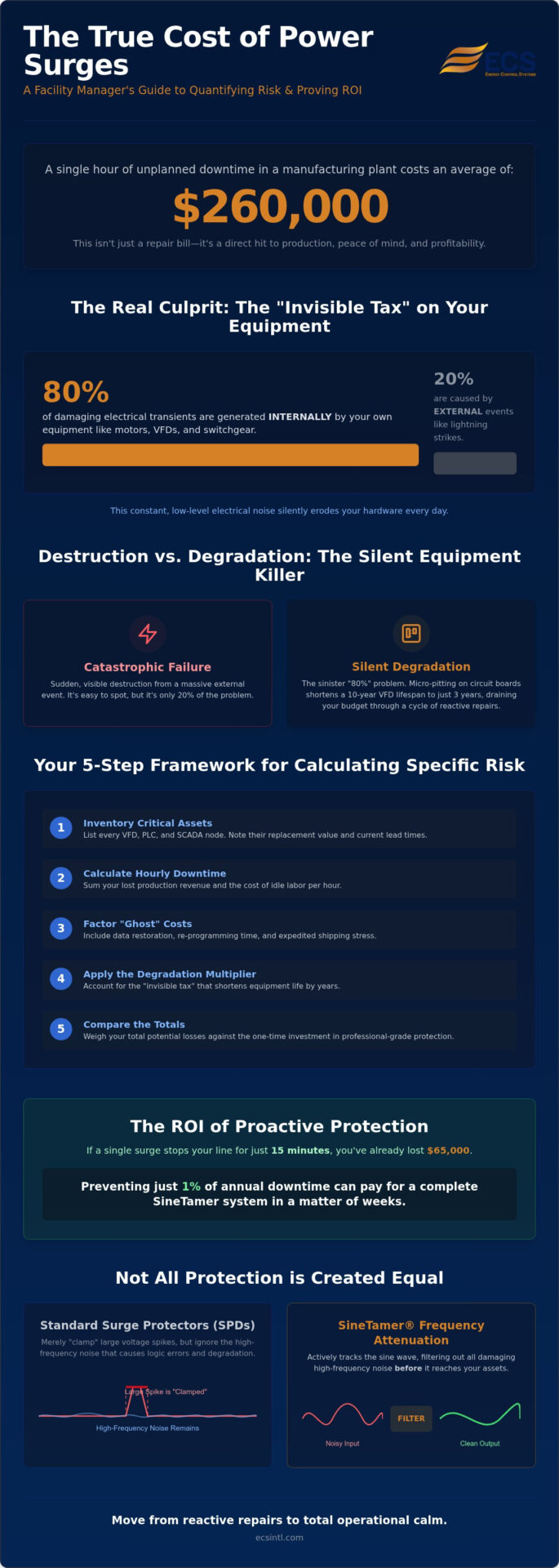
Most facility managers only worry about the “big bang” events like lightning strikes. But the real financial drain is an invisible tax. It’s the constant, low-level electrical noise generated inside your own four walls. In fact, 80% of transients are internally generated by your own motors and switchgear. They don’t cause smoke; they cause confusion. Calculating the cost of power surge damage requires you to account for these hidden interruptions that standard surge protective devices (SPDs) simply miss. These standard units wait for a massive Voltage spike to clamp down, but they ignore the high-frequency noise that causes logic errors in VFDs and PLCs. This constant bombardment strips away your sense of control. You’re left waiting for the next midnight breakdown, wondering why your “protected” equipment keeps failing. It’s an exhausting way to run a facility, and you deserve better.
Destruction vs. Degradation: The Silent Equipment Killer
Catastrophic failure is easy to spot. Degradation is much more sinister and expensive over time. Every time a low-level transient hits, it causes micro-pitting on sensitive circuit boards and microprocessors. You won’t see the damage today. Instead, you’ll see a VFD that should have lasted ten years fail in three. This physical erosion creates a cycle of reactive repairs that drain your budget and your energy. Transient-induced degradation is the primary cause of shortened electronic lifespans in industrial environments. When you calculate the true cost, you see it’s not just about the one-time repair. It’s about the lost years of service life and the constant threat of unplanned downtime.
A 5-Step Framework for Calculating Your Facility’s Specific Risk
You need a concrete strategy to justify your budget. Calculating the cost of power surge damage isn’t just about tallying invoices; it’s about proving the value of stability to your board. Start with a clear framework for quantifying economic costs. This moves you from guesswork to data-driven leadership. It restores your status as a proactive expert rather than a reactive repairman.
- Step 1: Inventory Assets. List every VFD, PLC, and SCADA node. Note their current replacement value and the current logistical lead times.
- Step 2: Calculate Hourly Downtime. Total your lost production revenue plus the cost of idle labor.
- Step 3: Factor Ghost Costs. Include data restoration, re-programming time, and the emotional toll of expedited shipping stress.
- Step 4: Apply the Degradation Multiplier. Account for the “invisible tax” that shortens equipment life by years through micro-pitting.
- Step 5: Compare the Totals. Weigh these potential losses against the one-time investment in SineTamer protection.
Mastering the Industrial ROI Calculation
Consider the manufacturing average of $260,000 per hour for unplanned downtime. If a single surge event stops your line for just fifteen minutes, you’ve lost $65,000. Preventing just 1% of annual downtime can pay for a SineTamer system in mere weeks. To find where your facility is most vulnerable, a professional harmonic analysis can uncover the hidden electrical disturbances that inflate these operational costs. This data empowers you to stop being the person who fixes breaks and start being the leader who prevents them. It’s time to restore your personal agency and secure the recognition you deserve for maintaining a stable, high-performing facility.
From Reactive Loss to Proactive ROI: The SineTamer Solution
You’ve done the math. You know the numbers. Calculating the cost of power surge damage reveals a stark reality: reactive maintenance is a slow leak in your facility’s profitability. It’s time to plug it. While standard surge protectors merely “clamp” large spikes, the SineTamer LA Series acts as a strategic shield rather than a simple component. It uses frequency attenuation to track the sine wave, filtering out the high-frequency noise that standard units ignore. This technological edge stops logic errors before they stall your line.
This isn’t just about hardware. It’s about restoring your personal agency. You can finally stop chasing glitches and start leading a stabilized, high-performing facility. When you present these findings to the board, focus on three key pillars to secure your budget:
- The verified hourly downtime cost of $260,000 for manufacturing.
- The 80% of transients that are currently eroding your assets from within.
- The shift from a reactive “fix-it” culture to a proactive stability model.
Frame your proposal as a status-building initiative. You’re protecting the company’s bottom line and the team’s mental well-being simultaneously. To further enhance the financial appeal, you can also explore how Engineered Tax Services can help identify tax incentives to offset these infrastructure costs; read more.
Securing Your Facility with Professional-Grade Protection
Digital assets require a specialized touch. The SineTamer RM Series provides dedicated protection for your rack-mounted technology, preventing the cascading failures that ripple through unprotected grids. A professional site analysis ensures that every vulnerability is addressed before it becomes a headline-making disaster.
You don’t have to carry the burden of potential failure alone. We’ve been battle-tested since 1987, and we’re ready to be your steady hand in this chaotic landscape. It’s time to trade the stress of midnight breakdowns for the confidence of a protected infrastructure. Speak with an ECS expert today to calculate your facility’s specific ROI.
Take Command of Your Facility’s Future
You’ve seen the data. You understand that the “invisible tax” of internal transients is eroding your equipment and your peace of mind. By calculating the cost of power surge damage using a comprehensive framework, you’re no longer guessing. You’re leading. We’ve been protecting global infrastructure since 1987 with proprietary SineTamer technology and expert harmonic analysis. This isn’t just about hardware; it’s about restoring your personal agency and ensuring your facility remains a beacon of stability. Stop the cycle of reactive repairs today. You have the tools, the data, and the expertise to secure your budget and your professional status.
Download our ROI Calculation Worksheet to start your journey toward operational tranquility. You deserve a stress-free work environment, and we’re here to help you build it.
Frequently Asked Questions
How do I calculate the specific cost of downtime for my manufacturing plant?
Start with this formula: (Lost Revenue + Idle Labor Costs + Material Waste) / Downtime Hours. This provides a specific baseline for calculating the cost of power surge damage across your entire line. You must also account for “catch-up” costs, such as technician overtime and expedited shipping fees for replacement parts. Having this concrete number transforms your budget request from a guess into a strategic business case.
What is the “Invisible Tax” in industrial power quality?
This term describes the silent, cumulative damage caused by low-level transients that occur every time a motor starts or stops. These events don’t cause immediate fire and smoke failure but instead erode the service life of your PLCs and VFDs. It’s a hidden financial leak that forces you into a cycle of reactive repairs, stripping away your operational agency and your valuable weekend time.
Can a standard surge strip protect my industrial VFD or SCADA system?
Consumer-grade strips are entirely insufficient for the high-stakes world of industrial automation. They lack the thermal capacity and frequency filtering required to protect sensitive SCADA nodes or high-horsepower VFDs from industrial-scale electrical noise. Relying on them puts your production at risk and leaves you vulnerable to the emotional stress of unexpected breakdowns. You need professional-grade protection that is built specifically for the factory floor.
How does SineTamer differ from a standard Surge Protective Device (SPD)?
While standard SPDs only clamp large voltage spikes, SineTamer provides active frequency attenuation. It tracks the sine wave to filter out high-frequency noise and ring-wave transients that cause microprocessor logic errors. This distinction is critical because it addresses the 80% of surges that are generated internally. It’s the only way to move from the chaos of constant glitches to a state of total operational calm.

Article by
Jeff Edwards
Founder of ECS International Inc. Edwards travels and speaks extensively in Latin America, Asia and Africa on the subject of power quality; transients and mitigating their impact on profitability. After graduating from Texas Tech University in Lubbock Texas, Edwards spent 9 years in the Telecommunications sector prior to founding Energy Control Systems in 1987 as a Texas based corporation selling surge suppression and UPS systems. The company has evolved into a global power quality products and energy efficiency concern with operations spanning South America, Asia, Europe and Africa.
Disclaimer
Some of the above information may be the opinion of the author.