

Imagine it’s 2:00 AM and your phone vibrates with another “unexplained” PLC communication error. You’ve spent weeks hunting this ghost in the machine while production stalls and your stress levels climb. You aren’t alone. With unplanned downtime in manufacturing now costing up to $260,000 per hour, these invisible electrical spikes are more than just a nuisance. They’re a direct threat to your facility’s health and your own peace of mind.
We understand the heavy burden of being on call for avoidable issues. This guide explores how advanced transient voltage suppression for industrial automation goes beyond basic surge protection to eliminate the silent killers of sensitive electronics. You’ll learn how to use frequency-tracking technology to restore total operational stability. We’ll cover the latest 2026 ISA standards and the strategic steps you can take to finally gain the professional respect you deserve as a proactive leader.
Key Takeaways
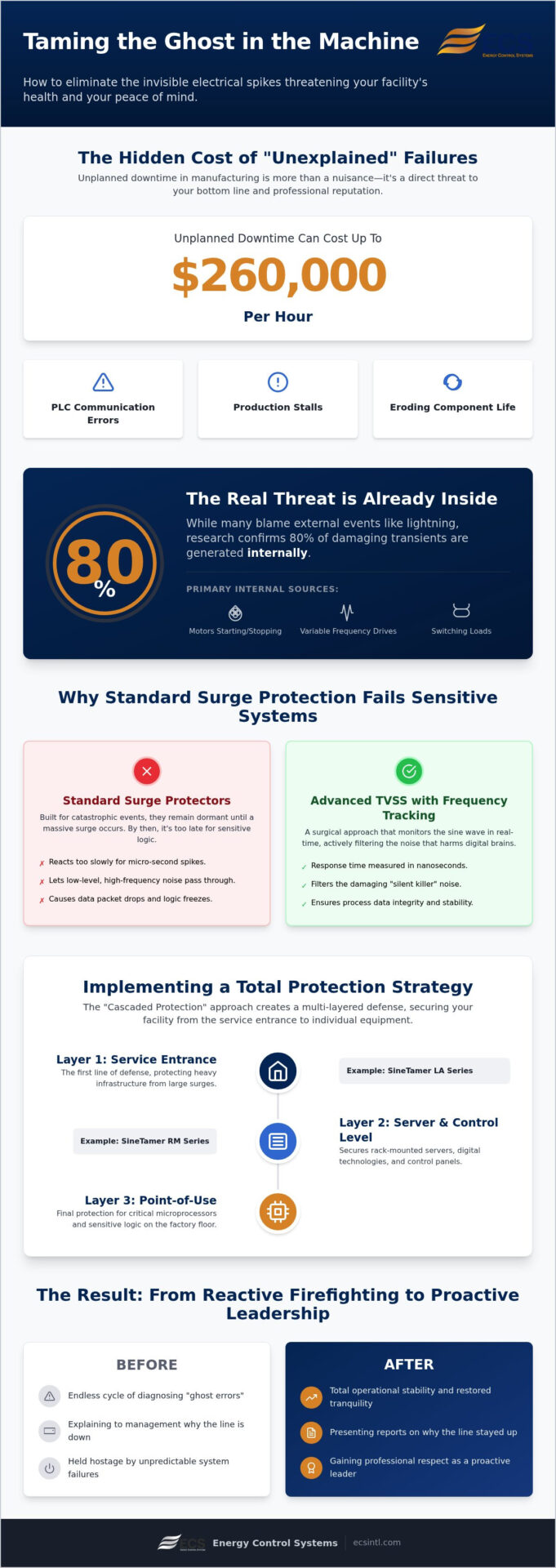
- Identify the “silent killers” by understanding that 80% of damaging transients are generated inside your facility rather than by external lightning strikes.
- Discover why frequency tracking is the superior method of transient voltage suppression for industrial automation compared to traditional clamping devices.
- Learn how to evaluate industrial suppressors using specific metrics like let-through voltage and response time to ensure your sensitive PLCs remain protected.
- Master the “Cascaded Protection” approach to secure everything from the service entrance to individual server racks, restoring your facility’s operational tranquility.
The Hidden Cost of Transient Voltage in Industrial Automation
Transient voltage suppression for industrial automation is the rigorous process of clamping micro-second voltage spikes to protect the sensitive logic within your facility. Most plant managers live with a constant, underlying anxiety. It’s that nagging fear that a “ghost error” will bring the line to a halt during your most critical shift. While many look toward the sky during a storm, the real threat is already inside. Research confirms that 80% of transients are generated internally by switching loads, motors, and variable frequency drives. These are the “silent killers” of your infrastructure. They don’t always cause an immediate explosion; instead, they slowly erode the life of your processors and communication ports. We believe you shouldn’t have to sacrifice your weekends to diagnose avoidable electrical instability.
Why Standard Surge Protection Fails Sensitive PLC and SCADA Systems
A basic Surge protector is often built for catastrophic events like lightning, but industrial logic requires a more surgical approach. Most standard surge protective device options remain dormant until a massive voltage surge occurs. By then, it’s too late for your sensitive scada systems. These digital brains are highly vulnerable to low-level, high-frequency noise that bypasses traditional hardware. This noise causes data packets to drop and logic to freeze, leaving you with a mess of communication errors. Clamping voltage is the specific level where a suppressor starts to divert energy. In the context of automation sensitivity, this clamping level must be incredibly precise to prevent even minor noise from corrupting your process data. True protection restores your agency and keeps your facility running smoothly.
Evaluating TVSS for High-Stakes Automation Environments
Evaluating transient voltage suppression for industrial automation requires moving beyond the outdated “lightning protection” mindset. While external surges are dramatic, your facility’s real enemy is high-frequency noise generated by internal switching. To regain control of your uptime, you must evaluate suppressors based on two non-negotiable metrics: response time and let-through voltage. By presenting a data-driven case for these power quality investments, you don’t just fix a machine. You establish yourself as a proactive leader who values operational stability over reactive firefighting. This shift restores your personal agency and ensures you aren’t held hostage by unpredictable failures. As you build your data-driven case, it can be helpful to explore Per-unit sales of industrial sensor hardware to gain insights into the latest durable sensing technologies available for smart factories.
The SineTamer LA Series provides a critical shield for heavy infrastructure, but the real magic happens at the microprocessor level. Response time must be measured in nanoseconds to protect sensitive digital controls. Standard SPDs often react too slowly, making them an incomplete solution for transient voltage suppression for industrial automation where precision is mandatory.
SineTamer’s frequency tracking technology aligns with the latest 2026 standards by monitoring the actual sine wave in real-time. It doesn’t just wait for a massive spike. It filters out the low-level noise that causes digital logic to stumble and earns you the respect of your peers. If you’re ready to secure your facility’s future, consider starting with a professional Harmonic Analysis to identify your specific vulnerabilities.
Implementing a Total Protection Strategy with SineTamer
Achieving total facility stability requires a “Cascaded Protection” approach. This hierarchy starts at your service entrance and moves systematically down to the sensitive logic on your factory floor. While the LA series handles the heavy infrastructure, the SineTamer RM Series secures your server-level and digital technologies. This multi-layered defense ensures that transient voltage suppression for industrial automation isn’t just a single barrier, but a comprehensive net. You move from the exhausting cycle of reactive firefighting to a position of proactive operational leadership. It is a fundamental shift. Instead of explaining why the line is down, you’re presenting reports on why it stayed up.
Restoring Operational Peace and Professional Agency
A professional harmonic analysis serves as your diagnostic map. It identifies hidden disturbances that eat away at your components before they cause a catastrophic failure. By mapping these electrical anomalies early, you regain your personal time and professional sanity. To achieve total, uninterrupted performance, integrating an uninterruptible power supply provides the final layer of defense against grid instability. This combination of frequency tracking and backup power creates an environment where “ghost errors” cannot survive. Your facility can be stable. You don’t have to live on the edge of the next breakdown. By implementing these strategies, you become the steady hand that restored tranquility to the production line. You deserve a workplace where technology supports your success rather than threatening it.
Take Control of Your Facility’s Operational Tranquility
You don’t have to accept unexpected downtime as an inevitable part of manufacturing. We’ve explored how internal transients act as silent killers and why traditional surge protection often leaves your sensitive logic exposed. By prioritizing transient voltage suppression for industrial automation through frequency tracking, you move from the chaos of constant repair to the confidence of a proactive leader. You’ve earned the right to a facility that runs smoothly and a schedule that belongs to you again.
With over 35 years of power quality expertise and proprietary frequency tracking technology, we’ve helped global industrial leaders eliminate the electrical noise that threatens their uptime. It’s time to stop chasing ghosts and start securing your infrastructure. Restore stability to your facility with SineTamer solutions. Your equipment can be protected, your production can be steady, and you can finally experience true operational peace.
Frequently Asked Questions
How does transient voltage affect PLC communication?
Transient voltage creates high-frequency noise that disrupts the low-voltage signals used by PLCs. This interference causes data packet loss and logic errors, often appearing as “ghost” communication faults that are nearly impossible to diagnose. By implementing transient voltage suppression for industrial automation, you eliminate these disruptions at the source. This protects your digital infrastructure and ensures your logic remains stable during high-demand production cycles.
What is the difference between a surge protector and a transient voltage suppressor?
A standard surge protector is designed for catastrophic, high-voltage events like lightning strikes. In contrast, a transient voltage suppressor specifically targets the low-level, high-frequency spikes that occur thousands of times daily from internal equipment switching. While basic protectors wait for a massive surge, our frequency tracking technology monitors the sine wave in real-time. This provides the continuous protection your sensitive automation components need to survive.
Can transient voltage suppression reduce my industrial downtime?
Yes, it’s one of the most effective ways to restore operational stability to your facility. Since 80% of transients are generated internally, suppressing these spikes prevents the slow degradation of electronic components. This proactive approach eliminates the unexpected equipment failures that lead to costly unplanned downtime. You stop reacting to emergencies and start leading a facility that runs with predictable, reliable precision every single day.
Is SineTamer compatible with existing SCADA and automation hardware?
Is SineTamer compatible with existing SCADA and automation hardware?

Article by
Jeff Edwards
Founder of ECS International Inc. Edwards travels and speaks extensively in Latin America, Asia and Africa on the subject of power quality; transients and mitigating their impact on profitability. After graduating from Texas Tech University in Lubbock Texas, Edwards spent 9 years in the Telecommunications sector prior to founding Energy Control Systems in 1987 as a Texas based corporation selling surge suppression and UPS systems. The company has evolved into a global power quality products and energy efficiency concern with operations spanning South America, Asia, Europe and Africa.
Disclaimer
Some of the above information may be the opinion of the author.