

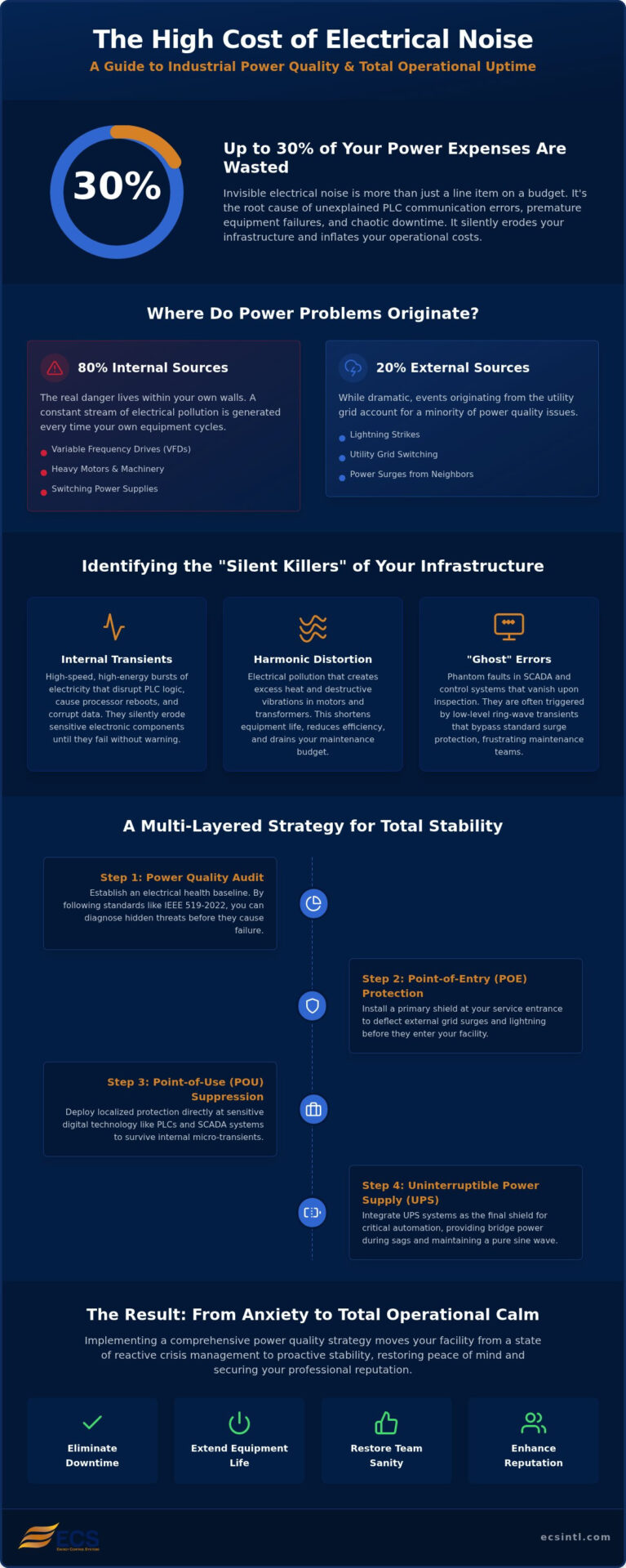
Up to 30% of your facility’s power-related expenses are likely being swallowed by invisible electrical noise. It isn’t just a line item on a budget; it’s the root cause of those midnight calls about unexplained PLC communication errors and the staggering costs of premature VFD failures. You’ve felt the operational chaos that follows an unpredictable power event. It’s exhausting. We believe you deserve a workplace defined by stability, not crisis. This 2026 guide reveals the essential industrial power quality improvement techniques needed to shield your sensitive electronic infrastructure from degradation. We’ll explore professional strategies and hardware solutions, such as harmonic analysis and advanced surge protection, to eliminate downtime for good. It’s time to restore your personal agency and gain the professional recognition that comes with a stabilized plant. Let’s move your facility from a state of anxiety to a state of total operational calm.
Key Takeaways
- Learn to differentiate between external utility-grid surges and the internal transients that quietly degrade your facility’s sensitive electronics.
- Discover essential industrial power quality improvement techniques, including how Point-of-Entry protection acts as a vital shield for your entire infrastructure.
- Understand how professional Harmonic Analysis serves as a diagnostic tool to stop the “silent killers” of motors before they lead to costly equipment replacement.
- Establish a structured path toward total operational uptime, restoring your peace of mind and securing your professional reputation as a proactive leader.
Identifying the Root Causes of Industrial Power Quality Degradation
In the high-stakes world of modern manufacturing, Electric power quality is defined by the stability and purity of your electrical waveform. It’s the lifeblood of your operation. While many facility leaders worry about external threats like lightning strikes or utility grid switching, these account for only about 20% of disturbances. The real danger lives within your own four walls. Internal transients cause a silent erosion of your sensitive electronics, slowly degrading components until they fail without warning. Transient voltage is a high-speed, high-energy burst of electricity that disrupts the delicate logic of PLC communication, causing unexpected processor reboots and data corruption. Understanding these internal sources is the foundation of effective industrial power quality improvement techniques.
The Hidden Impact of Internal Transients and Harmonic Distortion
Your own equipment is often the primary source of instability. Variable Frequency Drives (VFDs) and heavy motors generate significant internal noise and harmonic distortion every time they cycle. This creates a constant stream of electrical pollution that triggers ghost errors in your SCADA systems. We understand the deep frustration your maintenance team feels when they spend hours chasing phantom faults that vanish upon inspection. Standard surge protection usually fails because it isn’t engineered to catch 360-degree ring-wave transients. These low-level events bypass traditional surge strips, reaching deep into your sensitive digital infrastructure. Mastering industrial power quality improvement techniques means protecting your facility from the machines you use every day, ensuring your team can finally work in a state of calm rather than constant crisis.
Proven Mitigation Techniques for Modern Industrial Facilities
Stop reacting to failures and start preventing them. Effective industrial power quality improvement techniques begin with a site-wide audit to establish a baseline of your facility’s electrical health. You can’t fix what you haven’t measured. By following standards like IEEE 519-2022, you ensure your facility isn’t injecting harmful distortion back into the grid while protecting your own assets. Once you understand your unique electrical landscape, implement Point-of-Entry (POE) protection. This serves as your primary shield, deflecting external grid surges and lightning before they reach your sensitive equipment.
Next, deploy Point-of-Use (POU) suppression directly at your sensitive digital technology. PLCs and SCADA systems require this localized protection to survive the micro-transients that cause “ghost” errors and communication drops. Finally, integrate UPS systems to provide critical bridge power during voltage sags. This prevents the operational chaos of a sudden system reboot and the stress of a halted production line.
Implementing a Multi-Layered Protection Strategy
A cascaded defense is the only way to ensure total stability. High-quality surge protective devices at every level of your distribution system catch the transients that POE might miss. For your most critical automation, an uninterruptible power supply acts as the final shield. It maintains a pure sine wave even when the grid falters. You must balance hardware costs against the “unlimited” expense of production downtime and equipment replacement. Protecting your infrastructure restores your personal agency and protects your sanity. If you’re ready to secure your plant, a professional harmonic analysis can reveal the hidden threats currently heating your motors.
Executing a Power Quality Audit and Long-Term Stability Plan
True stability doesn’t happen by accident. Professional Harmonic Analysis is the essential first step for any facility upgrade. Think of it as the diagnostic that prevents the painful “surgery” of total equipment replacement. By interpreting harmonic data, you can pinpoint the silent killers of your infrastructure: excess heat and destructive vibration in your motors. These invisible forces shorten equipment life and drain your budget. Mastering industrial power quality improvement techniques allows you to transition from a cycle of stressful firefighting repairs to a status-elevating maintenance strategy. You aren’t just fixing machines; you’re securing the plant’s future. Our ultimate promise is the restoration of your mental tranquility through total electrical stability.
Leveraging Professional Harmonic Analysis and SineTamer Solutions
Your hardware must be as battle-tested as your team. The SineTamer LA Series is engineered to outperform generic SPDs, especially in high-vibration industrial environments where standard components fail. For your critical server-side digital technology, the SineTamer RM Series provides dedicated protection for your rack-mounted assets. These aren’t just components; they’re a shield for your sanity. Regain control of your facility today. By implementing these advanced industrial power quality improvement techniques, you establish yourself as a leader who prioritizes uptime and employee well-being. Your next step is requesting a technical site analysis to identify exactly where your infrastructure is vulnerable.
Securing Your Plant’s Future and Your Peace of Mind
You’ve seen how internal transients and harmonic distortion act as silent killers within your infrastructure. Stabilizing your plant isn’t just about hardware; it’s about reclaiming your time and your sanity. By mastering these industrial power quality improvement techniques, you move from the stress of constant repairs to the confidence of total operational uptime. We bring over 35 years of global expertise to your facility, utilizing proprietary SineTamer frequency attenuation technology to protect your sensitive electronics. These professional strategies can reduce industrial downtime by up to 80%, giving you the recognition you deserve for a job well done. Don’t let unpredictable power events dictate your schedule any longer. It’s time to take control. Restore your facility’s agency with a SineTamer Power Quality Audit and finally experience the mental tranquility of a truly stable environment. We’re here to help you succeed.
Frequently Asked Questions
What are the most common industrial power quality issues?
The most frequent disturbances include voltage sags, harmonics, and high-frequency transients. While lightning gets the headlines, internal transients generated by switching inductive loads like motors are far more common. These events cause silent erosion of electronics. Identifying these issues is the first step in implementing effective industrial power quality improvement techniques to protect your facility’s infrastructure.
How do internal transients differ from lightning surges?
Lightning surges are massive, external events that can cause immediate, catastrophic damage to your electrical system. In contrast, internal transients are smaller, high-frequency bursts generated inside your facility by equipment like VFDs. They occur thousands of times daily. While they don’t cause immediate fire, they slowly degrade digital components until your systems fail without warning.
Can harmonic distortion increase my industrial electricity bill?
Yes, harmonic distortion directly impacts your bottom line through increased energy waste and potential utility penalties. It creates non-working current that generates excess heat in your motors and transformers. This inefficiency forces your equipment to work harder and consume more power. By using professional industrial power quality improvement techniques, you can eliminate these hidden costs and restore efficiency.
Why do my PLCs keep resetting even with a standard surge protector?
Standard surge protectors are designed to stop large voltage spikes, but they often ignore the high-frequency “ring-wave” transients that disrupt digital logic. Your PLCs are sensitive to these micro-disturbances. To stop the resets, you need frequency attenuation technology that filters out the electrical noise. This level of protection restores your personal agency over the production line.
What is the difference between active and passive power quality improvement techniques?
Passive techniques use components like capacitors and inductors to filter noise and stabilize voltage. They are reliable and cost-effective for most facilities. Active techniques utilize power electronics to inject compensating current in real-time. While active systems are powerful, they are often more complex and expensive. Most industrial leaders find that a robust passive strategy provides the stability they need.

Article by
Jeff Edwards
Founder of ECS International Inc. Edwards travels and speaks extensively in Latin America, Asia and Africa on the subject of power quality; transients and mitigating their impact on profitability. After graduating from Texas Tech University in Lubbock Texas, Edwards spent 9 years in the Telecommunications sector prior to founding Energy Control Systems in 1987 as a Texas based corporation selling surge suppression and UPS systems. The company has evolved into a global power quality products and energy efficiency concern with operations spanning South America, Asia, Europe and Africa.
Disclaimer
Some of the above information may be the opinion of the author.