

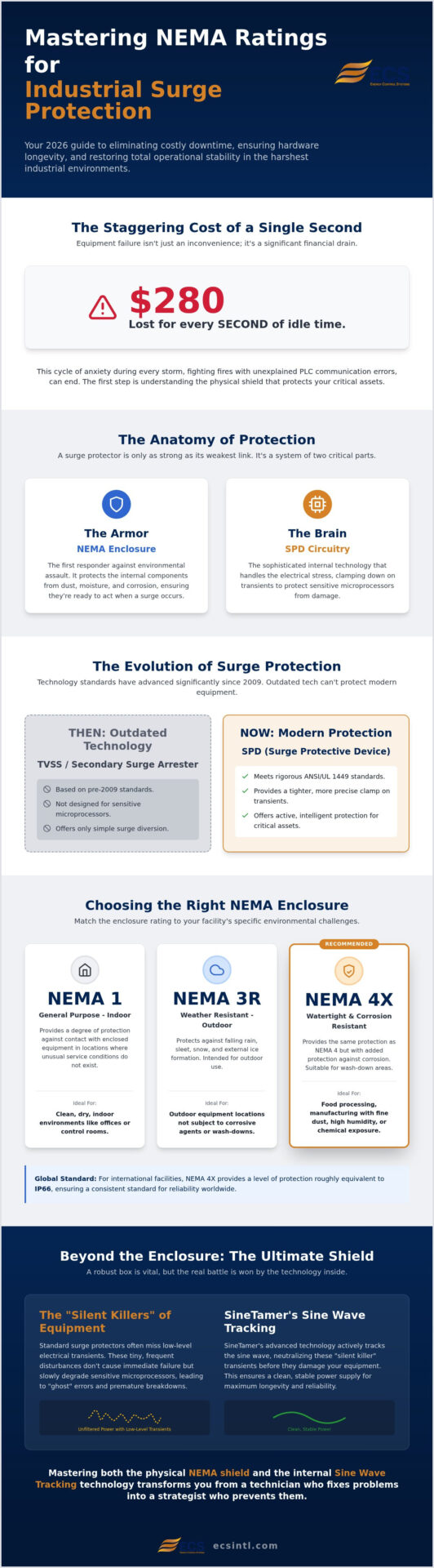
Industrial facilities can lose approximately $280 for every single second of idle time caused by equipment failure. It’s a staggering figure that represents more than just lost revenue. It’s the weight of missed deadlines and the exhaustion of fighting fires you thought were already out. You’ve likely experienced the frustration of unexplained PLC communication errors despite having protection. Understanding the correct NEMA ratings for surge protection devices is the first step toward ending this cycle of anxiety during every storm.
This 2026 guide helps you master the technical nuances required to ensure your hardware survives the harshest industrial environments. We provide a clear framework for specifying enclosures and mastering the latest standards. You’ll learn how to eliminate costly downtime, restore total operational stability, and finally reclaim your peace of mind.
Key Takeaways
- Stop viewing enclosures as just metal boxes and start seeing them as the first responders that ensure your hardware’s longevity.
- Use our clear framework to navigate the specific NEMA ratings for surge protection devices required for your unique facility conditions.
- Identify when NEMA 4X is necessary to protect against humidity and dust, helping you avoid the high cost of premature equipment failure.
- Master the synergy between physical shielding and Sine Wave Tracking to eliminate the hidden transients that cause unexplained PLC communication errors.
Decoding NEMA Ratings for Surge Protection: More Than Just a Metal Box
Your surge protector is only as strong as its weakest link. While the internal circuitry handles the electrical stress, the enclosure serves as the first responder against environmental assault. NEMA, or the National Electrical Manufacturers Association, sets the standards that determine if your device can survive the reality of your shop floor. Understanding NEMA enclosure types is about more than compliance; it’s about protecting your investment from dust, moisture, and corrosion.
There’s a critical distinction between the internal “brain” of the device and its external “armor.” High-quality NEMA ratings for surge protection devices ensure that the sophisticated components inside aren’t vulnerable to the environment before they ever have a chance to stop a surge. When you specify the correct housing, you gain a sense of professional agency. You aren’t just buying hardware; you’re securing the stability of your entire operation and eliminating the anxiety of unexpected failures.
The Evolution from TVSS to Modern Surge Protective Devices (SPD)
The industry underwent a massive transformation in 2009 when ANSI/UL 1449 shifted terminology from TVSS to SPD. If you’re still using terms like “Secondary Surge Arrester,” you’re looking at outdated technology that wasn’t built for today’s sensitive microprocessors. Modern SineTamer LA Series units are designed to meet these rigorous 2026 standards. Modern SPDs provide a tighter, more precise clamp on transients to prevent the micro-damage that old arresters simply couldn’t catch. This shift represents a move from simple diversion to active, intelligent protection for your most critical assets.
Choosing the Right NEMA Enclosure: A Framework for Industrial Environments
Selecting the right NEMA ratings for surge protection devices ensures that your hardware doesn’t fail before it even gets to work. It’s about your peace of mind. You need to know that when the next storm hits, your internal circuits are dry and debris-free. While cost is always a factor, the price of a failed enclosure is often a destroyed PLC. To understand the full scope of what you’re protecting, it helps to review what is a surge protective device and how it interacts with your infrastructure.
Choosing the correct NEMA ratings for surge protection devices requires looking at your specific micro-climate. For global managers, NEMA 4X roughly aligns with IP66, providing a standard for international reliability. Is NEMA 4X overkill for indoor use? Not if your facility deals with high humidity or fine particulate matter that can bridge contacts. If you aren’t sure which path to take, you can always ask an expert for a site-specific recommendation.
NEMA 1 vs. NEMA 4X: Matching Protection to the Factory Floor
A NEMA 1 enclosure is fine for a clean office, but it’s a liability in woodworking or milling. Fine dust and vibration can penetrate general-purpose seals, leading to internal arcing. If your process involves wash-downs or corrosive chemicals, 4X is the only way to ensure your SineTamer unit remains the seasoned protector it was designed to be. Investing in a higher rating now prevents the psychological burden of wondering if your equipment will survive the next shift.
| NEMA Rating | Environmental Suitability | Recommended SineTamer Series |
|---|---|---|
| NEMA 1 | Clean, indoor environments with minimal dust. | SineTamer RM Series |
| NEMA 3R | Outdoor use; protects against rain and ice. | SineTamer LA Series |
| NEMA 4X | Corrosive areas or heavy wash-down zones. | SineTamer ST-PCMF Series |
Beyond the Enclosure: Why SineTamer is the Ultimate Industrial Shield
A robust enclosure is vital, but the real battle happens inside the housing. While you’ve now mastered the selection of NEMA ratings for surge protection devices, the internal technology is what actually saves your production line. Standard devices often ignore low-level transients. These are the “silent killers” that slowly degrade your microprocessors until they fail without warning. The SineTamer LA Series utilizes advanced Sine Wave Tracking to catch these disturbances before they reach your sensitive equipment.
When you solve the mystery of “ghost” errors and premature equipment failure, you change your status within the company. You’re no longer just the person fixing things. You become the strategist who eliminated downtime. You deserve a partner that cares about your quality of life, not just a vendor selling hardware. ECS understands the logistical weight you carry. Our global distribution and battle-tested expertise ensure you have a steady hand to rely on, regardless of industry-wide supply chain struggles.
Frequency Attenuation: Protecting the Brains of Your Machinery
A standard metal box cannot stop high-frequency electrical noise from scrambling your PLC’s logic. This noise bypasses traditional surge suppression, leading to the communication errors that keep you in a state of constant anxiety. SineTamer’s unique frequency attenuation technology restores your personal agency by cleaning the power directly at the source. It’s the difference between merely surviving a storm and maintaining total operational stability every single day. While NEMA ratings protect the device from the world, SineTamer protects your world from the power grid. This dual-layered approach is how you secure a stress-free work environment and lasting professional success.
Secure Your Future Against Industrial Downtime
Matching the right NEMA ratings for surge protection devices to your specific environment is the foundation of a reliable power quality strategy. But the enclosure is only the first layer. True stability comes from eliminating the low-level transients that eat away at your microprocessors. Since 1987, SineTamer has been the seasoned protector for global industrial sites, utilizing proprietary frequency attenuation technology to stop the silent killers of productivity. We also offer expert harmonic analysis to identify hidden power killers that standard suppressors miss. You have the power to stop the cycle of unexplained failures and reclaim your status as a source of stability within your organization.
Restore your facility’s stability with SineTamer LA Series
Take the first step toward a stress-free work environment today. We’re here to help you protect what matters most and ensure your success is permanent.
Frequently Asked Questions
Can I use a NEMA 1 rated surge protector outdoors?
No, you cannot use a NEMA 1 rated device outdoors. These enclosures are designed strictly for general-purpose indoor use where they provide a basic level of protection against accidental contact. They lack the gaskets and seals required to keep out rain, snow, or sleet. Using one outside invites catastrophic failure and immediate safety risks for your facility.
What is the difference between NEMA 4 and NEMA 4X for SPDs?
The primary difference is that NEMA 4X provides superior protection against corrosion. While both ratings are watertight and dust-tight, the “X” indicates that the enclosure can withstand corrosive agents like salt spray or harsh industrial chemicals. For 2026 standards, specifying NEMA 4X ensures your surge protection survives in coastal or chemical processing environments where standard steel would quickly degrade.
Does a NEMA enclosure rating affect the UL 1449 performance of an SPD?
A NEMA rating does not change the electrical clamping voltage or let-through performance defined by UL 1449. However, the enclosure is critical for maintaining that performance over time. If the housing fails to keep out moisture or dust, the internal components will degrade. Choosing the right NEMA ratings for surge protection devices ensures the unit actually lives long enough to perform its job.
How do NEMA ratings compare to international IP ratings for surge protection?
NEMA ratings and IP ratings both measure enclosure effectiveness, but they aren’t identical. IP ratings strictly focus on protection against solids and liquids. NEMA ratings are more comprehensive, accounting for factors like corrosion resistance and construction. When specifying NEMA ratings for surge protection devices, remember that NEMA 4X offers verified resistance to environmental corrosion that IP66 ratings alone may not explicitly guarantee.

Article by
Jeff Edwards
Founder of ECS International Inc. Edwards travels and speaks extensively in Latin America, Asia and Africa on the subject of power quality; transients and mitigating their impact on profitability. After graduating from Texas Tech University in Lubbock Texas, Edwards spent 9 years in the Telecommunications sector prior to founding Energy Control Systems in 1987 as a Texas based corporation selling surge suppression and UPS systems. The company has evolved into a global power quality products and energy efficiency concern with operations spanning South America, Asia, Europe and Africa.
Disclaimer
Some of the above information may be the opinion of the author.