

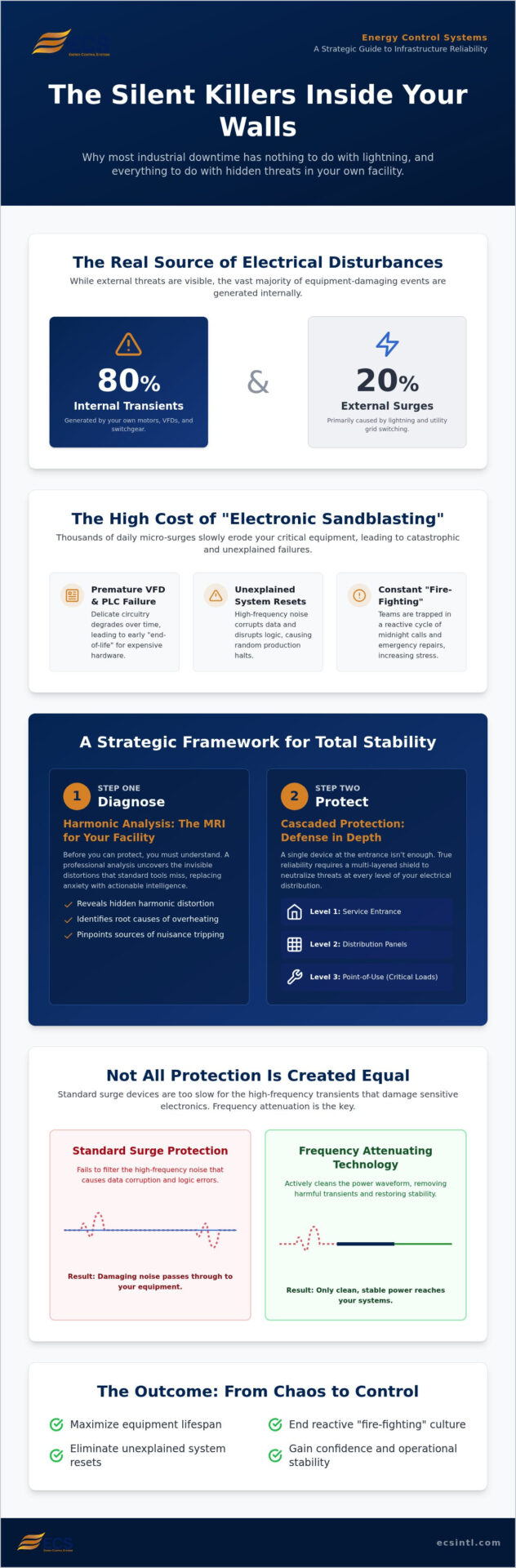
Your standard surge protection is likely missing the very thing that is killing your equipment. While most people fear lightning, 80% of industrial downtime is actually caused by internal electrical disturbances generated right inside your own walls. These invisible transients are the primary culprits behind unexplained PLC resets and the premature death of expensive VFDs. If you are exhausted by the emotional stress of midnight emergency repairs, it is time to focus on improving the electronic infrastructure reliability of your facility through a more strategic lens.
You deserve a plant that operates with total stability and a workspace that doesn’t feel like a ticking time bomb. We know the high stakes of a production halt and the personal toll it takes on your reputation when systems fail without warning. In this article, you will discover how to eliminate these silent electrical killers and create a quiet environment where your hardware actually reaches its full lifespan. We will explore how to align with the latest 2026 NEC standards and use precision analysis to ensure your facility can withstand any transient, giving you the confidence to lead your team toward permanent operational stability.
Key Takeaways
- Understand the critical difference between external lightning threats and the 80% of transients that originate inside your own facility.
- Learn how professional Harmonic Analysis acts as a diagnostic ‘MRI’ for your electrical system to uncover hidden vulnerabilities.
- Explore the strategic framework for improving the electronic infrastructure reliability through multi-layered, cascaded protection at every level.
- Discover how frequency-attenuating technology restores stability to sensitive SCADA and automation systems where standard surge devices fail.
- Gain the confidence to lead your plant toward a future where equipment lasts longer and your team is freed from the stress of constant fire-fighting.
What is Electronic Infrastructure Reliability and Why is it Failing?
Electronic infrastructure reliability is more than just a technical metric; it is the ability of your sensitive systems, including PLCs, VFDs, and SCADA networks, to operate without degradation or interruption. When these systems falter, your production halts and your stress levels spike. While following core Reliability engineering principles is essential for any facility, most operations fail because they focus on the wrong threats. They prepare for the rare lightning strike while ignoring the chaos happening inside their own panels.
You likely worry about external surges, yet the real “silent killer” of your equipment is the low-level transients generated by your own motors, switchgear, and drives. Roughly 80% of electrical disturbances are actually created inside your facility walls. If you are serious about improving the electronic infrastructure reliability of your plant, you must look beyond the utility entrance. These internal transients act like “electronic sandblasting.” They don’t always cause an immediate explosion; instead, thousands of daily micro-surges slowly erode delicate circuitry until a component fails for no apparent reason. When critical components do fail, sourcing verified replacements through C Plus Electronics, Inc ensures your facility can return to peak performance quickly.
This constant degradation forces your team into a state of reactive anxiety. You’re always waiting for the next midnight emergency call or the next unexplained reset. Moving toward proactive stability requires a shift in how you view power quality. It isn’t just about preventing fires; it’s about protecting the lifespan of every microprocessor in your building.
The Hidden Impact of Power Quality on Industrial Automation
Standard surge protection devices often fail because they are designed for large, slow surges. They simply aren’t fast enough to catch high-frequency ring-wave transients that disrupt sensitive logic. These high-speed disturbances create electrical noise that leads to corrupted sensor data in your digital technology. Transient voltage is the primary cause of premature electronic aging. When your data becomes unreliable due to this noise, your entire automation strategy begins to collapse, leading to the very downtime you’ve worked so hard to avoid.
A Strategic Framework for Improving Infrastructure Stability
You need a clear roadmap to move from operational chaos to total control. Guesswork is the enemy of uptime. Improving the electronic infrastructure reliability of your facility requires a systematic approach that identifies hidden vulnerabilities before they trigger a shutdown. By following a structured framework, you can transform your plant from a high-stress environment into a model of industrial stability.
Harmonic Analysis: The Diagnostic Key to Your Facility
Modern non-linear loads, such as LED lighting and VFDs, create harmonic distortion that pollutes your electrical system. You might notice symptoms like overheating transformers or breakers that trip for no apparent reason. These are red flags. A professional Harmonic Analysis acts as an MRI for your facility health. It reveals the invisible distortions in your watts that standard tools miss. This site-specific data is the only way to restore personal agency to the facility manager. It replaces anxiety with actionable intelligence.
Cascaded Protection: Defense in Depth
A single protector at the service entrance is a good start, but it isn’t enough to protect sensitive electronics. You need defense in depth. This involves implementing a cascaded strategy that places a high-quality surge protective device at every critical level of your distribution. While the entrance unit handles large external surges, point-of-use protection neutralizes the internal transients generated by your own equipment. For heavy industrial infrastructure, the SineTamer LA Series is the gold standard for shielding the microprocessors that drive your production.
Beyond surge protection, you must isolate sensitive server rooms and rack-mount equipment from the noisy factory floor. Electrical noise from large motors shouldn’t reach your data centers. Finally, bridge power gaps with an industrial-grade UPS to ensure SCADA uptime during momentary dips. This holistic view aligns with broader Critical Infrastructure Protection standards. It ensures your facility remains a steady hand in a chaotic technological landscape. If you’re tired of reactive repairs, a professional power quality assessment is the first step toward lasting relief.
Implementing the SineTamer Ecosystem for Total Operational Stability
True reliability isn’t just a technical achievement; it’s a restoration of your team’s potential. When you stop fire-fighting daily electrical glitches, you finally have the mental space to focus on innovation and growth. Improving the electronic infrastructure reliability of your facility means moving beyond basic surge protection. It requires an ecosystem that addresses the high-frequency events that standard devices simply ignore. By implementing frequency-attenuating technology, you create a “quiet” electrical environment where your equipment performs exactly as designed.
The SineTamer difference lies in its ability to track the frequency of the power wave. While traditional units wait for a massive voltage spike, SineTamer neutralizes the low-level transients that cause data corruption and logic resets. This precision leads to a significant long-term ROI. By eliminating the constant “electronic sandblasting” of your circuitry, you can extend the life of your expensive hardware by up to 30%. This reduction in maintenance overhead doesn’t just save money; it saves your reputation as a leader who delivers results.
The SineTamer LA and RM Series: Tailored Protection
Your facility has diverse needs that require specific solutions. We use the SineTamer LA Series to provide a primary shield for heavy machinery and industrial panels. For your sensitive data environments and SCADA networks, the SineTamer RM Series offers the rack-mount precision necessary to keep communication lines clear. Integrating a high-quality uninterruptible power supply ensures that your backup hours are maximized through clean, stabilized power delivery. SineTamer restores personal agency to the engineer by eliminating the “unexplained” failures that once undermined their professional authority.
Next Steps: From Chaos to Calm
The transition from a high-stress workplace to a center of industrial excellence begins with a single step. You don’t have to guess where your vulnerabilities lie. A technical site analysis identifies the specific gaps in your power quality, providing a logical path toward permanent stability. You deserve the confidence that comes with a battle-tested infrastructure. It is time to leave the anxiety of “what if” behind and embrace the tranquility of a facility that just works. Contact Energy Control Systems today for a comprehensive power quality audit.
Secure Your Facility’s Future with Proactive Power Quality
You don’t have to accept unexplained downtime as a necessary cost of doing business. By shifting your focus from external threats to the internal transients that cause 80% of your issues, you can finally move from a state of reactive stress to operational tranquility. We’ve explored how a cascaded defense strategy and precision diagnostics can transform your plant floor. Improving the electronic infrastructure reliability of your facility is a journey that replaces technical chaos with actionable intelligence and personal agency.
Since 1987, Energy Control Systems has served as a seasoned protector for industrial leaders across the globe. Our proprietary SineTamer frequency-tracking technology goes where standard surge devices cannot; it neutralizes the micro-surges that shorten the life of your expensive hardware. You have the power to restore stability to your plant and reclaim your team’s focus for innovation. Take the first step toward a quiet electrical environment and the professional recognition you deserve by reaching out to our experts.
Request Your Professional Harmonic Analysis & Infrastructure Audit
You’ve built a world-class operation. It’s time to ensure your power quality matches your standard of excellence. We are here to help you achieve the mental tranquility that comes with a truly reliable facility.
Frequently Asked Questions
What are the most common causes of electronic infrastructure failure?
The primary causes of failure are internally generated transients, which account for 80% of industrial downtime. While lightning gets the headlines, the daily switching of motors, drives, and contactors creates thousands of micro-surges that slowly degrade sensitive microprocessors. These invisible events lead to the unexplained PLC resets and data corruption that haunt your maintenance team. Addressing these internal silent killers is the most effective path toward improving the electronic infrastructure reliability of your plant.
How does harmonic distortion affect the reliability of my facility?
Harmonic distortion acts like a constant, low-level stressor on your entire electrical system. It is caused by non-linear loads like VFDs and LED lighting that pollute the power wave. This pollution causes transformers to overheat and breakers to trip without a clear overload. Over time, this heat accelerates the aging of your equipment. This leads to premature failures that force your team into high-stress emergency repairs during peak production hours.
What is the difference between a standard surge protector and the SineTamer LA Series?
A standard surge protector is designed only to catch large, slow voltage spikes, usually from external sources like lightning. In contrast, the SineTamer LA Series utilizes proprietary frequency-tracking technology. It neutralizes high-frequency ring-wave transients that standard devices simply ignore. This distinction is vital because those high-frequency events are what actually disrupt the logic of your sensitive PLCs and SCADA systems. SineTamer offers a level of protection that restores stability to your hardware and peace of mind to your staff.
Can a UPS improve my electronic infrastructure reliability on its own?
While an Uninterruptible Power Supply (UPS) is a critical safety net for bridging power gaps, it cannot solve every power quality issue by itself. A UPS protects against total outages and brownouts, but many units still pass through the internal transients that damage delicate circuitry. To truly succeed at improving the electronic infrastructure reliability of your facility, you must pair your UPS with frequency-attenuating surge protection. This combination ensures your automation systems have both the clean power they need to function and the backup they need to stay online.

Article by
Jeff Edwards
Founder of ECS International Inc. Edwards travels and speaks extensively in Latin America, Asia and Africa on the subject of power quality; transients and mitigating their impact on profitability. After graduating from Texas Tech University in Lubbock Texas, Edwards spent 9 years in the Telecommunications sector prior to founding Energy Control Systems in 1987 as a Texas based corporation selling surge suppression and UPS systems. The company has evolved into a global power quality products and energy efficiency concern with operations spanning South America, Asia, Europe and Africa.
Disclaimer
Some of the above information may be the opinion of the author.