

What if the primary threat to your plant’s uptime isn’t a mechanical failure you can see, but an invisible electrical disturbance you can’t? You’ve likely spent your weekend chasing unexplained PLC communication errors or rushing to the floor for a midnight repair on a failed drive. It’s exhausting to feel like you’re constantly reacting to a ghost in the machine while supply chain bottlenecks mount and pressure for total operational stability grows. When you’re focused on improving reliability in industrial automation equipment, you deserve a strategy that actually stops the cycle of crisis management. We understand the high emotional toll that comes with these high-stakes failures.
You already know that predictive maintenance is the modern standard, yet even the most advanced systems can’t protect against the transients that silently degrade sensitive electronics. We promise to show you how to eliminate these invisible disturbances and restore true peace of mind to your operations. In this article, we’ll explore why frequency-sensitive protection is the key to total stability and how moving toward a proactive maintenance culture can earn you the recognition you deserve for reducing plant downtime.
Key Takeaways
- Learn why standard surge protection often fails to protect sensitive SCADA systems from the high-frequency transients that cause most modern equipment failures.
- Discover how improving reliability in industrial automation equipment starts with a professional Harmonic Analysis to identify the invisible “dirty” power lurking in your facility.
- Explore the role of frequency-attenuating technology, like the SineTamer LA Series, in creating a “safety shield” for your critical micro-processors.
- Master the shift from a reactive “firefighting” mindset to a proactive maintenance culture that restores your personal agency and plant stability.
- See how stabilizing your electrical environment can significantly extend your Mean Time Between Failures, protecting both your hardware and your peace of mind.
The Hidden Enemy of Industrial Automation Reliability
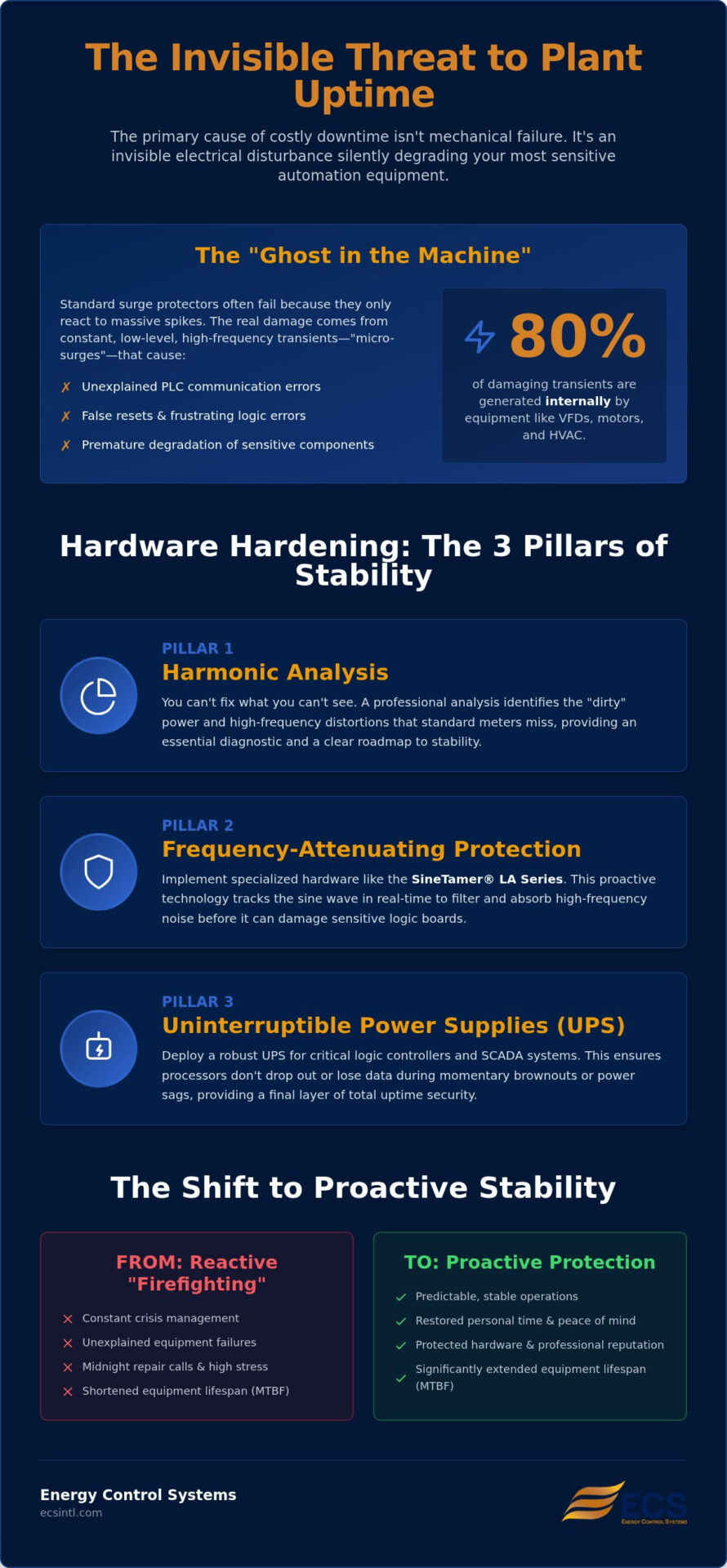
Reliability in 2026 is no longer just about mechanical wear and tear. It’s about the stability of micro-processors and the sensitive SCADA systems that act as the brain of your facility. When you’re focused on improving reliability in industrial automation equipment, you’re really protecting the delicate logic that governs every movement on your floor. Most facilities rely on standard surge protection; however, these devices often fail because they only watch for catastrophic spikes. The real killers are low-level, high-frequency transients. These “ghosts in the machine” cause logic errors, false resets, and communication dropouts that leave your team searching for answers that aren’t in the software logs.
Every time a PLC reboots unexpectedly, you lose more than just minutes of production. You lose data integrity and put unnecessary stress on your entire infrastructure. This stability is the foundation of industrial process control; if the controller isn’t electrically stable, the process can’t be reliable. It’s a cycle of invisible damage that compromises your uptime and your confidence.
Understanding the Transient Voltage Problem
Most people think of lightning strikes when they hear the word “surge.” While a direct strike is devastating, it’s a rare event. The real daily damage comes from “micro-surges” caused by motor switching, variable frequency drives, and even standard HVAC cycles. In a typical factory setting, roughly 80% of these transients are generated internally by your own equipment. These constant electrical hits don’t always blow a fuse. Instead, they slowly degrade sensitive components until they fail prematurely, often just after the warranty expires.
The Emotional Toll of Unplanned Downtime
We understand the weight of that 2:00 AM phone call. You drive to the plant in the dark, only to find a “no trouble found” error that magically clears after a simple power cycle. It’s an exhausting cycle that drains your energy and can damage your professional reputation. Improving reliability in industrial automation equipment isn’t just a technical metric; it’s about reclaiming your personal time and your weekends. By addressing power quality at the source, you move from a state of constant firefighting to a role of a seasoned protector. You deserve a work environment where “stability” is a reality, not just a goal on a spreadsheet.
Hardware Hardening: 3 Pillars of Equipment Stability
If the previous section identified the “ghosts” in your system, this section provides the physical armor to stop them. True stability isn’t found in a software patch. It’s built on a physical layer of defense. To begin improving reliability in industrial automation equipment, you must establish a foundation that can withstand the electrical chaos of a modern factory floor. We believe in a three-step approach that moves you from a state of vulnerability to one of complete control. These layers create a “safety shield” that software-only solutions simply cannot match.
- Step 1: Harmonic Analysis. You can’t fix what you can’t see. A professional Harmonic Analysis identifies the “dirty” power and distortions that standard meters miss. It’s the essential diagnostic step to restoring order.
- Step 2: Frequency-Attenuating Protection. Implementing specialized hardware like the SineTamer LA Series stops high-frequency noise before it reaches your logic boards.
- Step 3: Uninterruptible Power Supplies (UPS). Deploying a UPS for critical logic controllers ensures that your processors don’t drop out during a momentary brownout.
By integrating these pillars, you’re not just buying hardware; you’re investing in your own professional success and the Machine Reliability for Industrial Automation that your organization demands. It’s about protecting your equipment and your reputation simultaneously.
The SineTamer LA Series Advantage
Standard surge protectors are reactive; they wait for a massive spike to occur. The SineTamer LA Series is proactive. It tracks the actual sine wave in real-time to catch the low-level transients that others miss. This level of precision is critical for improving reliability in industrial automation equipment, especially in high-vibration or heavy-start environments where electrical noise is constant. It acts as a seasoned protector for your most sensitive processors.
Integrating UPS for Total Uptime
A reliable uninterruptible power supply does more than just provide battery backup. It bridges the gap during brownouts that would otherwise cause a PLC to reset and lose critical data. For your server rooms and rack-mounted infrastructure, the SineTamer RM Series provides the specialized protection needed to maintain data integrity. If you’re ready to stop the “unexplained” failures, starting with a professional Harmonic Analysis is the most direct path to relief.
Restoring Operational Agency and Long-Term Stability
The shift from a reactive “firefighting” culture to a proactive “protector” mindset is the final step in improving reliability in industrial automation equipment. You’ve spent too long at the mercy of intermittent errors that no one else could explain. By stabilizing your electrical environment, you’re not just fixing a machine; you’re fixing your schedule. Industry insights regarding reliability improvement in process control show that consistent power quality is the backbone of modern throughput. In fact, creating a stable power environment can extend your Mean Time Between Failures (MTBF) by up to 30%. This translates directly to lower maintenance costs and higher output. More importantly, it positions you as the internal hero who finally solved the “unsolvable” glitches that plagued the plant for years.
Beyond the Hardware: A Global Partnership
Since 1987, ECS has been a steady hand for facilities facing complex power quality challenges across the globe. We don’t view surge protective devices as mere commodities or disposable line items in a budget. They are strategic investments in your quality of life and your plant’s longevity. We aren’t just vendors; we are partners in your stability, providing the technical expertise needed to navigate a chaotic technological landscape. You deserve a partner that cares about your results as much as you do.
Next Steps for Your Facility
Where should you begin? The journey to improving reliability in industrial automation equipment often starts at the main service entrance to stop external surges from entering your grid. However, protecting the point of use is equally critical for the internal transients generated by your own drives and motors. Before you purchase any hardware, a technical site analysis is the most responsible first step. It ensures your solution is tailored to your specific electrical footprint. This structured path moves you from chaos to calm, restoring your agency over the machines you manage and giving you back your peace of mind.
Secure Your Plant’s Future Through Electrical Stability
You’ve seen how invisible electrical disturbances can dismantle even the most advanced automation strategies. By identifying the “dirty” power lurking in your facility and deploying a layered defense, you can finally stop the cycle of emergency repairs. Real progress in improving reliability in industrial automation equipment happens when you address the physical layer of your infrastructure. We’ve been serving global industries since 1987 with proprietary frequency-tracking technology that protects your most sensitive electronics. Our dedicated technical support team is here to help automation engineers like you move from a reactive state of constant anxiety to a proactive state of total control.
You don’t have to carry the burden of unexplained downtime alone. It’s time to reclaim your weekends and restore stability to your production floor. If you’re ready to eliminate the “ghosts in the machine” and secure your professional reputation, take the first step today. Request a Professional Harmonic Analysis to Secure Your Uptime and start your journey toward a stress-free work environment. We’re here to protect your equipment and your peace of mind.
Frequently Asked Questions
How do low-level transients affect PLC reliability?
Low-level transients degrade the micro-processors inside your PLC by causing “logic swings” that the controller interprets as valid data. This leads to unexplained resets and communication dropouts that don’t always blow a fuse but do cause significant downtime. While these hits don’t cause immediate smoke, they create the “ghosts in the machine” that force you into reactive firefighting. Over time, this constant electrical stress shortens the lifespan of sensitive internal components and ruins your peace of mind.
What is the difference between a standard SPD and a SineTamer device?
Standard surge protective devices (SPDs) are designed to clamp high-voltage spikes, usually triggered by external events like lightning. In contrast, SineTamer utilizes proprietary frequency-tracking technology to catch low-level transients that standard units miss. This is a game-changer for improving reliability in industrial automation equipment because it filters out the high-frequency noise generated by your own motor switching and drives. It acts as a proactive protector rather than a reactive clamp.
Can harmonic distortion cause equipment to overheat and fail prematurely?
Yes, harmonic distortion creates significant heat within motors, transformers, and cabling. This extra thermal stress breaks down insulation and forces cooling systems to work harder, leading to premature component failure. We recommend starting with a professional Harmonic Analysis to identify these hidden inefficiencies. It’s the first step toward restoring operational stability and protecting your hardware from the unnecessary wear that leads to expensive midnight repairs.
Is it necessary to protect every machine, or just the main power panel?
Protecting the main power panel only addresses external surges, but roughly 80% of transients are generated inside your facility by your own equipment. For true stability, you need a layered approach that includes point-of-use protection for your most critical machines. This “safety shield” ensures that the noise from one large motor doesn’t compromise the sensitive electronics in a nearby PLC. It’s a strategic investment in improving reliability in industrial automation equipment at every level of your operation.

Article by
Jeff Edwards
Founder of ECS International Inc. Edwards travels and speaks extensively in Latin America, Asia and Africa on the subject of power quality; transients and mitigating their impact on profitability. After graduating from Texas Tech University in Lubbock Texas, Edwards spent 9 years in the Telecommunications sector prior to founding Energy Control Systems in 1987 as a Texas based corporation selling surge suppression and UPS systems. The company has evolved into a global power quality products and energy efficiency concern with operations spanning South America, Asia, Europe and Africa.
Disclaimer
Some of the above information may be the opinion of the author.