

It’s 2:00 AM. Your phone vibrates with a critical SCADA alarm, and you already know the culprit. Another “unexplained” PLC communication error has halted your pumps, forcing you into a high-stakes emergency repair while the community sleeps. You’re likely exhausted by this cycle of failure and the mounting regulatory pressure to maintain 24/7 uptime under the 2026 National Electrical Code. Implementing advanced surge protection for water treatment plants is no longer just a technical recommendation. It is your primary defense against the electrical noise that threatens your facility’s heartbeat.
We understand the stress of managing critical infrastructure when the equipment seems to be working against you. In this article, you’ll discover how to eliminate costly downtime and protect your sensitive SCADA systems from both external lightning and the internal transients that account for 80% of electrical damage. We will preview the latest 2026 NEC mandates and show you how a total protection strategy can extend the lifespan of your electronics. It’s time to trade midnight crises for total operational stability and the professional recognition you’ve earned for reducing facility maintenance costs.
Key Takeaways
- Learn why 80% of electrical damage is actually generated inside your facility and how to stop the “silent noise” that slowly degrades your automation systems.
- Understand the 2026 NEC mandates that make robust surge protection for water treatment plants a legal requirement for maintaining critical operational uptime.
- Identify the specific vulnerabilities of your Variable Frequency Drives (VFDs) and how to shield them from being both sources and victims of power transients.
- Discover how the SineTamer LA Series provides a multi-layered defense to secure your service entrance and protect sensitive SCADA controllers from grid-level surges.
- Master a proactive strategy that replaces the stress of emergency repairs with long-term stability, earning you recognition for significantly lower maintenance costs.
The High Stakes of Power Quality in Water and Wastewater Treatment
Managing a water treatment facility is a high-pressure balancing act. You are tasked with preventing environmental spills and ensuring uninterrupted service for thousands of residents. In this environment, a single equipment failure isn’t just a technical glitch; it’s a potential public health crisis. Effective surge protection for water treatment plants must be viewed as a multi-layered defense system, shielding everything from massive pump motors to the delicate microprocessors in your control room.
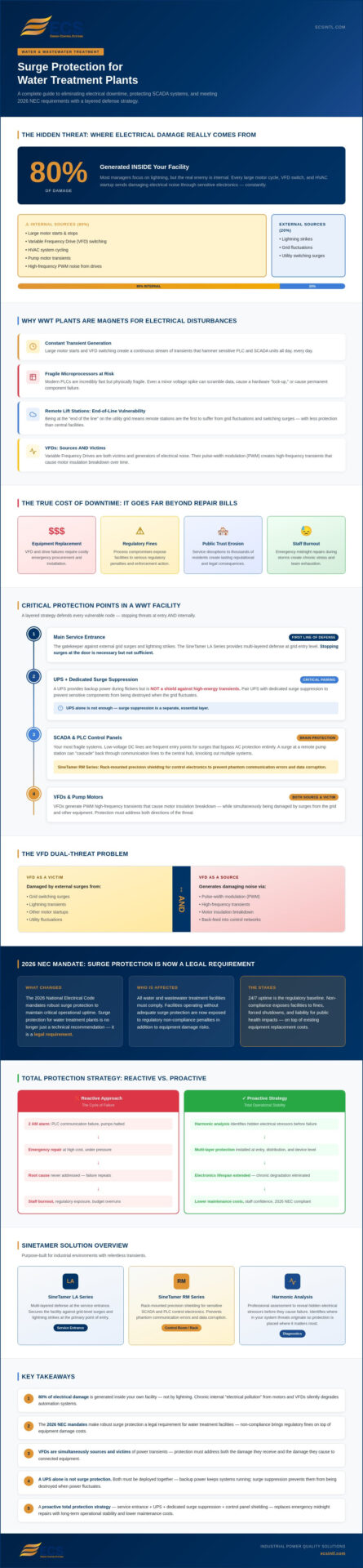
While many people focus on the dramatic threat of lightning, the real enemy is often invisible. Up to 80% of damaging surges are actually generated internally. Every time a large motor cycles or a HVAC system kicks in, it sends a ripple of electrical noise through your sensitive electronics. A standard surge protector might handle a single spike, but it often fails to address the chronic degradation caused by this constant “electrical pollution.” Standard surge protective devices simply aren’t built for the relentless transients found in a modern pump station.
Why WWT Plants Are Magnets for Electrical Disturbances
Your facility is a complex ecosystem of heavy machinery and high-speed automation. Large motor starts and VFD switching create a constant stream of transients that hammer your sensitive PLC and SCADA units. These modern microprocessors are incredibly fast but physically fragile. Even a minor voltage spike can scramble data or cause a hardware “lock-up.” Remote lift stations face even higher risks. Being at the “end of the line” for the utility grid makes them the first to suffer from grid fluctuations and switching surges.
The True Cost of Downtime: Beyond Repair Bills
The financial impact of a failed drive is obvious, but the psychological toll on your staff is often overlooked. There is a specific kind of exhaustion that comes from emergency midnight repairs during a storm. Beyond the stress, you face the looming threat of regulatory fines and the erosion of public trust if a process is compromised. We believe you deserve better than a life of constant fire-fighting. Operational relief is the natural result of a stabilized power environment where you can trust your systems to perform under pressure.
Critical Protection Points: Securing the WWT Infrastructure
Building a resilient facility requires more than a single device at the gate. To achieve true surge protection for water treatment plants, you must implement a layered strategy that defends every vulnerable node. Your main service entrance is your first line of defense. It stands as the gatekeeper against external grid surges and the violent energy of lightning strikes. However, stopping a surge at the door isn’t enough if the threat is already inside your walls.
Total uptime depends on a partnership between hardware solutions. Many managers rely solely on an uninterruptible power supply to keep systems running during a flicker. While a UPS provides temporary power, it is not a shield against high-energy transients. You must pair your backup power with dedicated surge suppression to prevent sensitive components from frying the moment the grid fluctuates. If you are unsure where your greatest risks lie, a professional harmonic analysis can reveal the hidden stressors in your electrical system.
Protecting the Brain: SCADA and PLC Control Panels
Your SCADA system is the brain of your operation, yet it’s often the most fragile. Low-voltage DC lines are frequent entry points for surges that completely bypass your AC protection. We often see a “cascade” effect where a surge at a remote pump station travels back through communication lines to the central processing hub, knocking out multiple systems at once. For your rack-mounted control electronics, the SineTamer RM Series provides the precision shielding needed to prevent these “phantom” communication errors and data corruptions.
VFD and Pump Protection: Stopping the Cycle of Failure
Variable Frequency Drives (VFDs) are essential for efficiency, but they are both sources and victims of electrical noise. The pulse-width modulation (PWM) they use to control motors generates high-frequency transients that cause “insulation breakdown” in your pump motors. This leads to premature winding failure and the high stress of emergency replacements. Specialized SPDs absorb this high-frequency noise before it can do damage. Industry data indicates that suppressing transients at the VFD level can extend motor life by up to 30%.
Implementing a Total Protection Strategy with SineTamer
True operational stability requires more than just buying parts off a shelf. To implement effective surge protection for water treatment plants, you need a strategy tailored to your facility’s unique electrical footprint. The SineTamer LA Series stands as the industry standard for this level of rugged, high-performance protection. It isn’t just about blocking a spike. It’s about cleaning the power that feeds your most critical assets. At ECS, we provide more than hardware. We provide a path to mental tranquility. We want to help you reclaim your personal agency by ending the exhausting “firefighting” mode of maintenance that drains your team’s energy.
Every facility has its own signature of electrical noise. A “one-size-fits-all” retail approach often leaves gaps in your defense, especially when dealing with the complex harmonics of large-scale pumping. We prioritize site-specific technical analysis to ensure your protection is precise and effective. This level of planning transforms your role from a reactive repair technician into a proactive leader who secures the community’s water supply.
The Power of Harmonic Analysis in Water Treatment
Sometimes, the ghost in your machine isn’t a surge at all. Harmonic distortion often mimics surge symptoms, causing “mysterious” resets and overheating that standard protectors can’t touch. We believe in a diagnostic-first approach. By performing a professional harmonic analysis, we identify the root cause of your equipment’s erratic behavior. This ensures you aren’t just treating a symptom but solving the actual problem. It’s the difference between a temporary fix and a permanent resolution for your power quality.
A Global Legacy of Protection
For over 30 years, ECS has been a battle-tested protector of critical infrastructure across the globe. We understand the specific logistical struggles of the 2026 industrial market, from supply chain shifts to evolving regulatory standards. You aren’t just hiring a vendor. You’re partnering with a veteran who has seen it all and remains focused on your individual success. Empower your team to focus on water quality, not power failures. Let us provide the steady hand that keeps your facility running exactly as it should.
Reclaiming Your Facility and Your Peace of Mind
The days of constant firefighting are over. You now have the roadmap to move from reactive emergency repairs to a state of total operational stability. By identifying your critical protection points and addressing the “silent noise” of internal transients, you’ve taken the first step toward a more reliable facility. Implementing robust surge protection for water treatment plants isn’t just about meeting the 2026 NEC mandates; it’s about protecting your quality of life and the community you serve.
We bring over 30 years of industrial power expertise to your doorstep. Backed by proprietary SineTamer frequency attenuation technology and a global distribution network, we provide the stability you need. You deserve to walk through your facility with confidence, knowing your SCADA and VFD systems are shielded by a veteran protector. It’s time to stop worrying about the next storm and start focusing on the professional success you’ve worked so hard to achieve.
Secure your facility’s future with SineTamer power quality solutions.
You’ve earned the respect of your organization. Now, let us help you maintain it with a power environment that stays as steady as your commitment to water quality.
Frequently Asked Questions
Is lightning the most common cause of equipment failure in water treatment plants?
No, lightning is not the primary cause of failures. While a strike is catastrophic, up to 80% of damaging power surges are generated internally within your facility. These transients come from the constant cycling of large equipment like motors and HVAC systems. Truly securing your infrastructure requires a strategy that addresses these daily, silent stressors rather than just waiting for the occasional storm event to hit.
Can I use standard industrial surge protectors for my VFDs?
Standard industrial surge protectors are often insufficient for VFDs because they are typically voltage-actuated. VFDs generate high-frequency noise through pulse-width modulation that can bypass basic protectors. You need specialized surge protection for water treatment plants that utilizes frequency attenuation circuitry. This technology specifically absorbs the high-frequency transients that cause insulation breakdown and premature motor failure, extending the life of your equipment significantly.
How do I know if my SCADA communication errors are caused by electrical noise?
Unexplained PLC lock-ups, “phantom” communication drops, and corrupted data packets are classic signs of electrical noise. If these errors happen without a clear mechanical cause or coincide with large motor starts, transients are likely the culprit. We often recommend a professional harmonic analysis to identify if these “mysterious” resets are actually the result of poor power quality degrading your sensitive microprocessors over time.
Does a water treatment plant need both a UPS and a surge protective device?
Yes, you absolutely need both to ensure total uptime. A UPS provides bridge power during a total loss or flicker, but it is not designed to stop high-energy surges or clean up high-frequency noise. Pairing your UPS with a dedicated surge protective device ensures that your sensitive electronics are shielded from damage while they wait for the backup power to engage or the grid to stabilize.
What is the difference between a surge arrester and a surge suppressor in a WWT environment?
A surge arrester is typically installed at the utility entrance to handle massive, high-voltage external events like lightning strikes. A surge suppressor, or SPD, is used downstream to protect specific equipment from lower-level, high-frequency internal transients. In a wastewater environment, you need both: an arrester to guard the gate and high-performance suppressors to protect your VFDs and SCADA controllers from constant internal electrical pollution.
How often should surge protection devices be inspected at a pump station?
We recommend inspecting your surge protection for water treatment plants every six to twelve months as part of your routine preventive maintenance schedule. You should also perform a visual check after any major lightning event or significant utility grid work in your area. Regular monitoring ensures that your defense remains active and ready, giving you the peace of mind that your facility is continuously protected.

Article by
Jeff Edwards
Founder of ECS International Inc. Edwards travels and speaks extensively in Latin America, Asia and Africa on the subject of power quality; transients and mitigating their impact on profitability. After graduating from Texas Tech University in Lubbock Texas, Edwards spent 9 years in the Telecommunications sector prior to founding Energy Control Systems in 1987 as a Texas based corporation selling surge suppression and UPS systems. The company has evolved into a global power quality products and energy efficiency concern with operations spanning South America, Asia, Europe and Africa.
Disclaimer
Some of the above information may be the opinion of the author.