

Your “maintenance-free” batteries are likely the single greatest threat to your facility’s uptime. It is a frustrating cycle that many plant managers know too well. You invest in a robust UPS system to sleep better at night, yet you still find yourself standing in front of upper management explaining why a “protected” load just crashed. The stress of unpredictable power failures and the rising costs of VRLA replacements can make you feel like you’re constantly chasing a moving target. You deserve a system that actually works when the grid doesn’t.
This industrial ups battery maintenance guide is designed to hand that control back to you. We have built this resource to help you master the essential protocols required to extend battery life, prevent catastrophic downtime, and restore your professional confidence. We will explore the shift toward lithium-ion technology under the new IEEE 2962-2025 standards and debunk the dangerous myths that lead to premature cell failure. From temperature management to total cost of ownership, we provide a clear, actionable roadmap to help you become the steady hand your organization relies on for stability.
Key Takeaways
- Identify the subtle warning signs of battery decay before they trigger a catastrophic facility shutdown and damage your professional reputation.
- Use this industrial ups battery maintenance guide to transition from stressful emergency repairs to a calm, predictive maintenance framework.
- Learn why even the highest-quality batteries fail prematurely without a holistic defense against “dirty power” and harmonic distortion.
- Discover how a battle-ready backup system restores your personal agency and eliminates the burden of explaining preventable downtime to management.
- Master the critical safety protocols and testing standards required to secure your facility’s infrastructure and your own peace of mind throughout 2026.
The Hidden Killers of Industrial UPS Batteries
Your battery is the most vulnerable link in your facility’s infrastructure. It’s the silent heart of your Uninterruptible Power Supply, but it’s also the most likely component to fail when you need it most. When a battery bank fails, the consequences aren’t just technical. They’re deeply personal. It means explaining to stakeholders why a “protected” system crashed, losing hours of critical data, and watching your facility’s reputation for reliability erode in real-time. You shouldn’t have to carry the burden of “unexplained” failures when the causes are often hiding in plain sight.
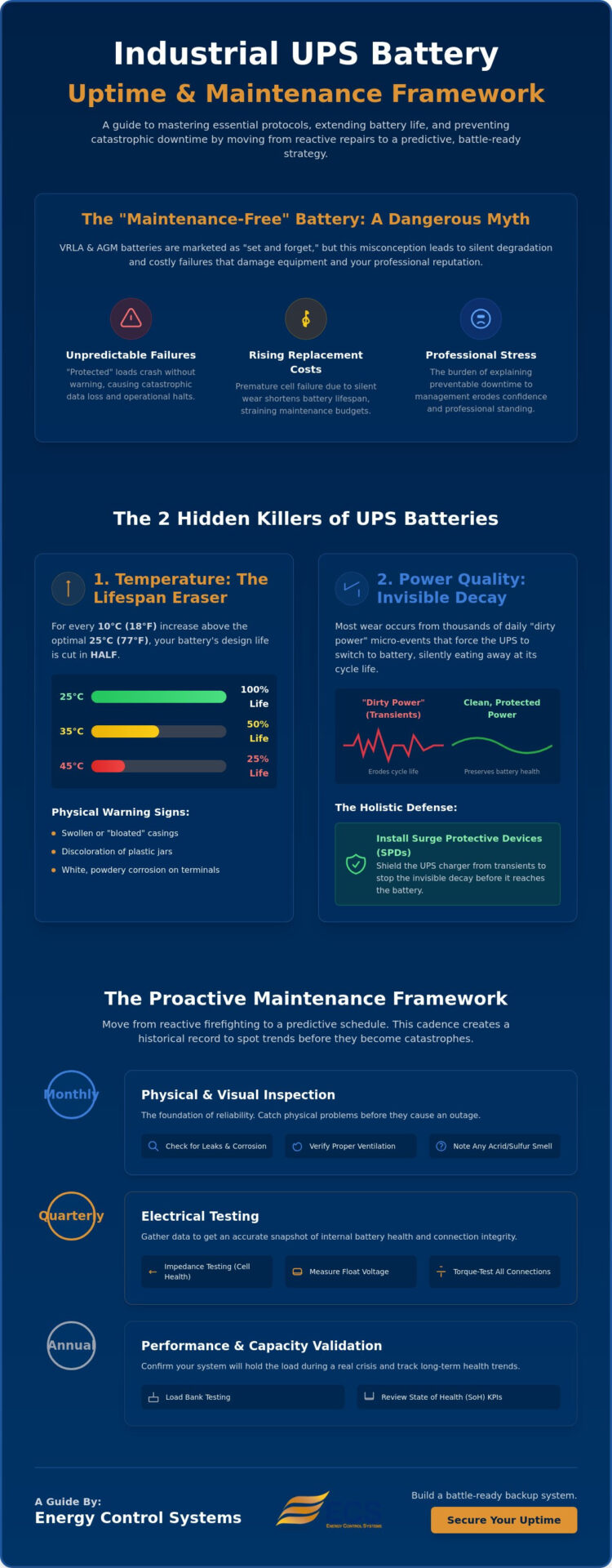
Developing a robust industrial ups battery maintenance guide is the only way to move from a state of constant anxiety to one of total control. Many facilities rely on Valve Regulated Lead Acid (VRLA) batteries, including the popular Absorbent Glass Mat (AGM) variety. While these are marketed as “maintenance-free,” that’s a dangerous myth. They don’t require water, but they do require vigilant monitoring of charging voltages and terminal integrity. Without this oversight, low-level transients and electrical noise quietly degrade your battery’s charging efficiency, leaving you with a system that looks healthy on a screen but fails the moment the lights flicker.
Temperature: The Silent Lifespan Eraser
Heat is a relentless predator in the battery room. You must respect the 10-degree rule: for every 10°C increase above the optimal 25°C operating temperature, your battery’s life is cut in half. If your room consistently runs hot, a five-year battery can become a two-year liability before you even notice. You can spot the damage if you know where to look. Watch for swollen casings that look “bloated,” discoloration of the plastic jars, or white, powdery corrosion blooming around the terminals. These visual cues are your last warning before a total cell collapse.
The Role of Power Quality in Battery Health
Most battery wear doesn’t happen during a blackout. It happens during the thousands of micro-events that plague your grid every day. Low-level transients and “dirty power” force your UPS to switch to battery power momentarily, even for a fraction of a second. These tiny events eat away at your “cycle life” with every engagement. To stop this invisible decay, you must install surge protective devices to shield the UPS unit itself. Protecting your battery starts with stabilizing the power quality that feeds the charger.
The 2026 Framework for UPS Battery Maintenance
Stop firefighting. The mental exhaustion of reacting to every alarm and explaining “unexplained” outages is a burden you shouldn’t have to carry. You deserve the peace of mind that comes from knowing your facility is battle-ready. By transitioning from a reactive mindset to a proactive, predictive framework, you reclaim your personal agency and your schedule. This industrial ups battery maintenance guide provides the structure you need to move from anxiety to absolute confidence in your backup systems.
Working around high-voltage industrial battery strings requires more than just technical skill; it requires a deep respect for safety. Before you begin any service, ensure your team is fully compliant with OSHA battery safety regulations. Establishing a consistent maintenance cadence is the foundation of reliability. Monthly visual checks, quarterly electrical testing, and annual performance reviews create a historical record that allows you to spot trends before they become catastrophes.
Physical and Visual Inspection Protocols
Start with the basics. Look for signs of “thermal runaway,” such as leaking electrolyte or an acrid, sulfurous smell that indicates a cell is failing. Next, you must torque-test every connection. Loose terminals cause micro-arcing and localized heat buildup, which can lead to fires even if the battery itself is healthy. Finally, clean all terminals with approved neutralizing agents. Removing dirt and corrosion prevents high-resistance paths that force your charger to work harder than necessary.
Electrical Testing and Performance Analytics
Physical checks aren’t enough. You need data. While conductance testing is common, impedance testing provides a more accurate snapshot of internal health by tracking the resistance within each cell. To truly verify your uninterruptible power supply hours, you must perform periodic load bank testing. This is the only way to confirm your system will hold the load during a real crisis. State of Health (SoH) is the primary KPI for your replacement cycles, representing the percentage of a battery’s original capacity that remains today. If you’re struggling to maintain these standards, a professional Harmonic Analysis can help identify the root causes of premature aging in your system.
Beyond the Battery: A Holistic Defense Strategy
A perfect battery bank won’t save your facility if the electrical environment surrounding it is hostile. You can follow every step in this industrial ups battery maintenance guide, but if your power quality is compromised, you’re still at risk. It’s a heavy burden to manage equipment that seems destined to fail despite your best efforts. You deserve a solution that addresses the root cause of the chaos. Stabilizing your entire electrical ecosystem is the only way to restore your personal agency and ensure the long-term health of your infrastructure. We don’t just want your UPS to stay online. We want you to feel the relief of a system that finally behaves as promised.
Integrating Surge Protection for UPS Longevity
Transients are the silent predators of the industrial world. They don’t just threaten the batteries; they attack the sensitive logic boards that control the entire charging cycle. When these boards degrade, the UPS can no longer manage the battery strings effectively, leading to premature failure. The SineTamer LA Series acts as a primary shield for your UPS infrastructure. It eliminates the high-energy surges and low-level transients that wear down components. By installing this level of protection, you aren’t just buying hardware. You’re securing your facility’s future and protecting your own professional standing.
The Power of Professional Harmonic Analysis
Non-linear loads in modern plants create “dirty power” that manifests as harmonic distortion. This distortion causes internal overheating in UPS transformers and battery cells, even when the ambient temperature is perfect. A professional harmonic analysis provides the visibility you need to see what’s really happening on your lines. This isn’t just a technical report. It’s the data you need to justify infrastructure upgrades to upper management. It transforms you from a technician into a strategic leader who understands the high stakes of power quality. When you eliminate these hidden stressors, you finally achieve the mental tranquility that comes with a truly stable system. No more guessing. No more anxiety. Just the clarity of a battle-tested facility.
Secure Your Reliability and Your Peace of Mind
You’ve seen how the hidden killers of heat and electrical noise can quietly compromise your facility’s heartbeat. Following this industrial ups battery maintenance guide is your first step toward shifting from the exhaustion of firefighting to the calm of predictive success. By mastering physical inspections and electrical analytics, you move beyond simple hardware management. You become the steady hand that ensures your organization’s stability even when the grid fails. You deserve the professional recognition that comes with a perfectly maintained infrastructure.
True protection doesn’t end at the battery terminal. It requires a holistic defense that addresses the “dirty power” stressing your entire system. We bring over 35 years of power quality expertise to your facility. With our global distribution of SineTamer protection technology and specialized harmonic analysis for complex industrial sites, we help you eliminate the root causes of downtime. You don’t have to face these technical complexities alone. We are here to serve as your partner in stability.
Request a Professional Site Analysis to Protect Your UPS Infrastructure and reclaim your personal agency today. You have the tools to secure your facility’s uptime. It’s time to build a future defined by tranquility and professional triumph.
Frequently Asked Questions
How often should industrial UPS batteries be replaced?
Most industrial lead-acid batteries require replacement every three to five years to ensure total reliability. While some modules are marketed for longer life, real-world conditions like heat and power fluctuations often accelerate chemical decay. You shouldn’t wait for a total failure to act. Following a consistent industrial ups battery maintenance guide helps you track capacity loss so you can schedule replacements before an outage puts your facility at risk.
What is the difference between VRLA and AGM batteries in a UPS system?
VRLA is the broad category of Valve Regulated Lead Acid batteries, while AGM is a specific technology within that family. In an AGM battery, the electrolyte is absorbed into fiberglass mats rather than flowing freely as a liquid. This design makes them spill-proof and more resistant to vibration. Both types are common in UPS systems because they don’t require water replenishment, yet they still demand regular electrical testing to ensure they remain battle-ready.
Can I replace just one bad battery in a UPS string?
You should avoid replacing a single battery in an older string whenever possible. A new battery has much lower internal resistance than its aged counterparts, which creates an electrical imbalance during the charging cycle. This imbalance typically leads to the overcharging of older cells or the undercharging of the new one. This cycle eventually kills the entire string prematurely, leaving you with the same stress and downtime you were trying to avoid.
How does ambient temperature affect UPS battery life?
Heat is the primary enemy of lead-acid battery chemistry and can quickly halve your system’s lifespan. The ideal operating temperature is 77°F. For every 15°F increase above this baseline, the chemical reactions inside the battery accelerate so rapidly that the expected life of the unit drops by 50%. Maintaining a cool, stable environment is one of the simplest ways to protect your equipment and your facility’s uptime.
What are the first signs of a failing industrial UPS battery?
Physical deformities like swollen or bloated battery casings are the most urgent warning signs of failure. You might also notice an acrid smell similar to rotten eggs or see white, powdery corrosion blooming around the terminals. These indicators suggest the battery is venting gases or leaking electrolyte. If you spot these signs, you must act immediately to restore the integrity of your backup system before a catastrophic failure occurs.
Is it safe to perform UPS maintenance while the system is online?
Visual inspections are safe while the system is online, but you should engage the maintenance bypass for any physical repairs or terminal tightening. Even when the system is disconnected from the main grid, high-voltage energy remains stored in the battery strings. You must always use insulated tools and wear appropriate personal protective equipment. Adhering to the safety standards in your industrial ups battery maintenance guide ensures you protect yourself while securing your plant’s power.

Article by
Jeff Edwards
Founder of ECS International Inc. Edwards travels and speaks extensively in Latin America, Asia and Africa on the subject of power quality; transients and mitigating their impact on profitability. After graduating from Texas Tech University in Lubbock Texas, Edwards spent 9 years in the Telecommunications sector prior to founding Energy Control Systems in 1987 as a Texas based corporation selling surge suppression and UPS systems. The company has evolved into a global power quality products and energy efficiency concern with operations spanning South America, Asia, Europe and Africa.
Disclaimer
Some of the above information may be the opinion of the author.