

What if the glowing green light on your electrical panel is actually a lie? You’ve felt that sinking pit in your stomach when an automated line goes down even when your protection status claims everything is fine. It is exhausting to manage a facility where silent electrical threats bypass your defenses. Identifying the signs your surge protector needs replacing is the only way to prevent a single transient event from turning into a costly disaster. You deserve better than a sacrificial device that quits without warning.
We believe in restoring your personal agency and protecting your hard-earned reputation. This guide provides a clear checklist to help you secure your infrastructure and move toward true industrial-grade protection. We will explore everything from the impact of the 2026 NEC updates to the hidden degradation of internal components. We’re here to help you regain control of your power environment. It is time to restore the operational stability and mental tranquility your team depends on.
Key Takeaways
- Stop trusting the green light. Learn to spot the thermal damage and circuit exhaustion that signal your protection has reached its end of life.
- Recognize the critical signs your surge protector needs replacing, including those “ghost” reboots and data corruption errors that plague automated lines.
- Master the facility audit process to document the age and viability of every surge protective device across your infrastructure.
- Connect the dots between unexplained downtime and external grid events to identify silent degradation before your equipment pays the price.
- Move from the anxiety of potential failure to the calm of operational stability with a strategic replacement plan.
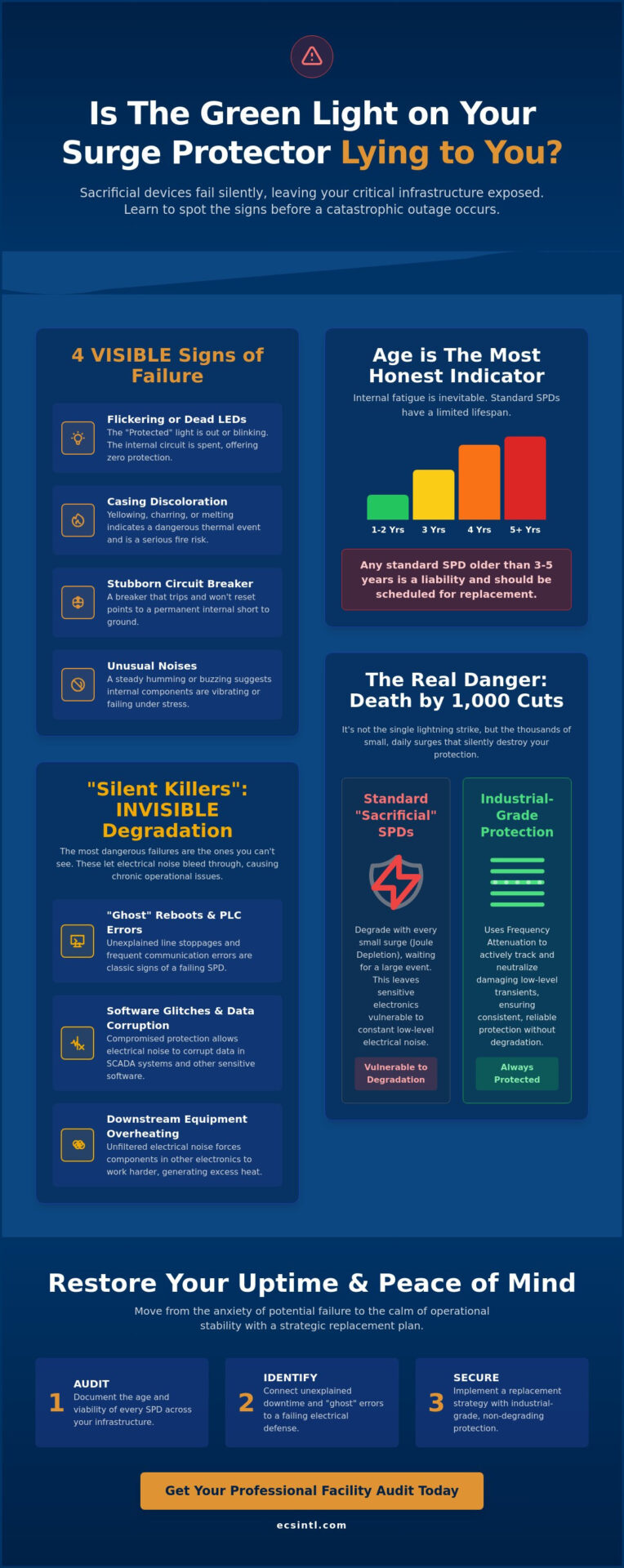
Beyond the Indicator Light: 4 Visible Signs Your Surge Protector is Failing
Your facility depends on stability. When a surge protective device begins to fail, it often leaves clues that are easy to overlook until the damage is done. Recognizing the clear signs your surge protector needs replacing can be the difference between a productive shift and a catastrophic outage. Don’t ignore these four warning signs. They are the voice of your electrical system asking for help.
- Flickering or Dead LEDs: If the “Protected” light is out or blinking, the internal circuit is likely spent. The device is now just a glorified power strip.
- Casing Discoloration: Yellowing, charring, or melting around the outlet indicates a dangerous thermal event has already occurred. This is a fire risk.
- A Stubborn Breaker: A breaker that trips and refuses to reset often points to a permanent internal short to ground. The device is trying to protect you by staying off.
- Unusual Noises: A steady humming or buzzing sound suggests internal components are vibrating or failing under electrical stress.
The Problem with “Always-On” Indicator Lights
Many operators rely solely on a green LED for peace of mind. This is a high-stakes gamble. Understanding how surge protectors work reveals that these lights often only indicate a complete circuit, not the health of the protection. In critical server rooms, a light might stay green even after the protective components have degraded by 50% or more. Your equipment is essentially unprotected, yet the light remains a comforting, false promise. You deserve certainty, not a guess.
Physical Deterioration vs. Internal Fatigue
Internal fatigue is silent, but physical signs are emergencies. If you notice the sharp smell of ozone or burnt plastic, replace the unit immediately. It’s a signal that the device can no longer handle the load. Environmental factors also play a role. For instance, high humidity in Fort Worth plants can accelerate casing failure and internal corrosion. These external signs your surge protector needs replacing are your last warning. We want you to feel confident in your infrastructure, not worried about what’s happening behind the panel. Replacing a compromised unit today restores your operational safety tomorrow.
The Silent Killers: Identifying Invisible Surge Protector Degradation
You’ve been there. The line stops. No obvious reason exists for the failure. You check the logs, but everything looks normal. These “ghost” reboots and frequent PLC communication errors are often the subtle signs your surge protector needs replacing. When your surge protection begins to fail internally, it doesn’t always go out with a bang. Instead, it lets through just enough electrical noise to cause software glitches and data corruption in your SCADA systems. You might even notice downstream electronics overheating for no clear reason. These aren’t just technical hiccups. They are symptoms of a compromised defense system that is no longer shielding your investment.
Age is the most honest indicator of health. Any standard surge protective device (SPD) older than 3 to 5 years is a liability. It doesn’t matter if the casing is pristine or the room is climate-controlled. Internal fatigue is inevitable. If your protection was installed before 2022, it’s likely reached its end-of-life. We want to help you move from a state of constant troubleshooting to a state of total operational calm. Identifying these invisible threats is the first step toward restoring your facility’s stability.
Why Thousands of Small Surges are More Dangerous Than One Lightning Strike
Most facility managers fear the single, massive lightning strike. However, the real danger is transient degradation. This process occurs when thousands of 100-volt spikes slowly eat away at sensitive silicon components over time. Standard sacrificial MOVs are designed to wait for a large event to react. This leaves your equipment vulnerable to smaller, constant “bites” of energy. In contrast, the SineTamer LA Series uses a frequency-attenuation approach to track and eliminate these low-level transients before they can do damage.
When to Suspect Your Protection Has “Timed Out”
Every device has a limit. Joule depletion is essentially the internal battery life of a surge protector; once those joules are spent, the protection is gone. If you’re seeing unexplained downtime, a professional harmonic analysis can reveal if your current SPDs are still doing their job or if they’ve quietly retired on the job.
Restoring Uptime: The Professional Audit and Replacement Strategy
Operational chaos doesn’t have to be your baseline. Once you recognize the signs your surge protector needs replacing, the path forward is a structured audit that restores your facility’s stability. Start by performing a comprehensive inventory of every surge protective device currently in service. Document their installation dates and exact locations. You can’t protect what you don’t track. By correlating your equipment downtime logs with local weather events or utility grid switching, you will see the patterns that manual inspections miss. This data-driven approach moves you from reactive repairs to proactive leadership.
True protection requires looking deeper than just voltage spikes. We recommend scheduling a professional Harmonic Analysis to identify if electrical noise is the silent thief stealing your equipment’s lifespan. Often, it isn’t a single surge but continuous “dirty” power that causes the most frustration. For your most critical server racks and control centers, upgrading to an uninterruptible power supply ensures that even a total grid failure won’t compromise your data integrity. This is how you reclaim your time and your peace of mind.
Choosing Your Next Shield: SineTamer RM and LA Series
Standard sacrificial strips are a temporary fix for a permanent problem. For modern digital technology, the SineTamer RM Series provides rack-mount protection that does more than just clamp high voltages. It filters the power. This “set and forget” approach offers a superior ROI by extending the life of your hardware and preventing the micro-damage that leads to premature failure. You stop being a firefighter and start being a strategist. With the 2026 National Electrical Code (NEC) expanding requirements for surge protection, choosing high-performance filtration ensures your facility remains both compliant and resilient.
The Final Step: Professional Site Analysis
Secure Your Infrastructure and Reclaim Your Peace of Mind
You’ve seen how a simple green light can mask the decay of your facility’s defenses. Whether it’s the physical charring of a spent unit or the “ghost” reboots of an aging system, these signs your surge protector needs replacing are urgent calls to action. You don’t have to live with the anxiety of the next storm or grid switch. True operational stability comes from moving beyond sacrificial components to high-performance filtration that actually cleans your power.
With over 30 years of industrial power quality expertise, Energy Control Systems provides the steady hand you need to navigate technical complexity. Our SineTamer proprietary frequency-attenuation technology protects your equipment from the silent erosion of transients. We offer global distribution and comprehensive technical site analysis to ensure you have the data needed to make informed decisions. Don’t wait for the next reboot; get a professional Harmonic Analysis and SineTamer audit today.
You have the power to protect your equipment and your professional reputation. We’re here to help you restore the tranquility and stability your facility deserves. Let’s secure your success together.
Frequently Asked Questions
Do surge protectors really expire if no major surge occurred?
Yes, surge protectors expire because they absorb thousands of small voltage spikes that gradually wear down their internal components. This process, known as joule depletion, happens even without a single catastrophic event. Every small transient acts like a tiny bite out of your device’s protective capacity. Eventually, the internal components are spent, and your equipment is left vulnerable to the next power fluctuation. You shouldn’t wait for a failure to realize your protection is gone.
How many years does an industrial surge protector typically last?
Most industrial surge protectors have a functional lifespan of 3 to 5 years. While the casing might look perfect, the internal chemistry of sacrificial components degrades with every hour of operation. If your facility is in a high-lightning area or has a noisy electrical grid, you might see the signs your surge protector needs replacing much sooner. Regular audits are the only way to ensure your defense is still active and your team is safe.
Can a surge protector still work if the “Grounded” light is off but “Protected” is on?
No, your equipment is not safe if the ground indicator is extinguished. A surge protector needs a solid path to ground to divert excess energy away from your sensitive electronics. If the ground connection is lost, the “Protected” light is essentially a false promise. You’re risking a hardware failure and potential fire hazard by continuing to use a device with an ungrounded connection. It is time to restore your facility’s safety with a new unit.
What happens if I don’t replace a surge protector that has reached its end of life?
Ignoring a spent surge protector leaves your infrastructure completely exposed to the chaotic reality of the modern power grid. You’ll likely experience unexplained downtime, hardware failures, and corrupted data in your SCADA systems. The emotional toll of constant troubleshooting and operational failure is high. Replacing these units is a small price to pay for the mental tranquility and operational stability your team deserves. We want to help you regain control of your power quality.
How can I tell if my surge protector was damaged by a recent lightning strike?

Article by
Jeff Edwards
Founder of ECS International Inc. Edwards travels and speaks extensively in Latin America, Asia and Africa on the subject of power quality; transients and mitigating their impact on profitability. After graduating from Texas Tech University in Lubbock Texas, Edwards spent 9 years in the Telecommunications sector prior to founding Energy Control Systems in 1987 as a Texas based corporation selling surge suppression and UPS systems. The company has evolved into a global power quality products and energy efficiency concern with operations spanning South America, Asia, Europe and Africa.
Disclaimer
Some of the above information may be the opinion of the author.