

What if that glowing green light on your electrical panel is actually lying to you? It’s a common frustration for facility managers who feel the heavy weight of leadership’s demand for 100% uptime. You see an indicator light and assume your equipment is safe, but invisible degradation often happens long before a failure occurs. This is why a rigorous surge protector maintenance checklist 2026 is no longer optional. With the 2026 National Electrical Code now mandating surge protection for critical standby systems and expanded sleeping quarters, your audit process must evolve to meet these high-stakes requirements.
We understand the anxiety that comes with managing complex power infrastructure. You deserve to feel confident in your facility’s resilience, not just hopeful. This article provides a definitive framework to audit and verify your protection status, ensuring you have the documented proof needed for insurance and compliance. We’ll preview the latest 2026 NEC standards, including the 10kA minimum discharge ratings and new GFCI requirements for outdoor HVAC units. By the end of this guide, you’ll have a clear path to restore your peace of mind and protect your professional reputation.
Key Takeaways
- Stop chasing “ghost in the machine” PLC errors by shifting from reactive repairs to proactive verification of your suppression integrity.
- Audit the physical health of your infrastructure by inspecting enclosures for thermal stress and ensuring every conduit connection remains rock-solid.
- Use technical verification tools like surge counters and thermal imaging to identify internal degradation that indicator lights often miss.
- Adopt a structured surge protector maintenance checklist 2026 to provide documented proof of compliance and reliability for your leadership team.
- See how SineTamer’s frequency-active tracking goes beyond standard MOV clipping to simplify your maintenance schedule and restore your peace of mind.
The Criticality of Surge Protector Maintenance in 2026
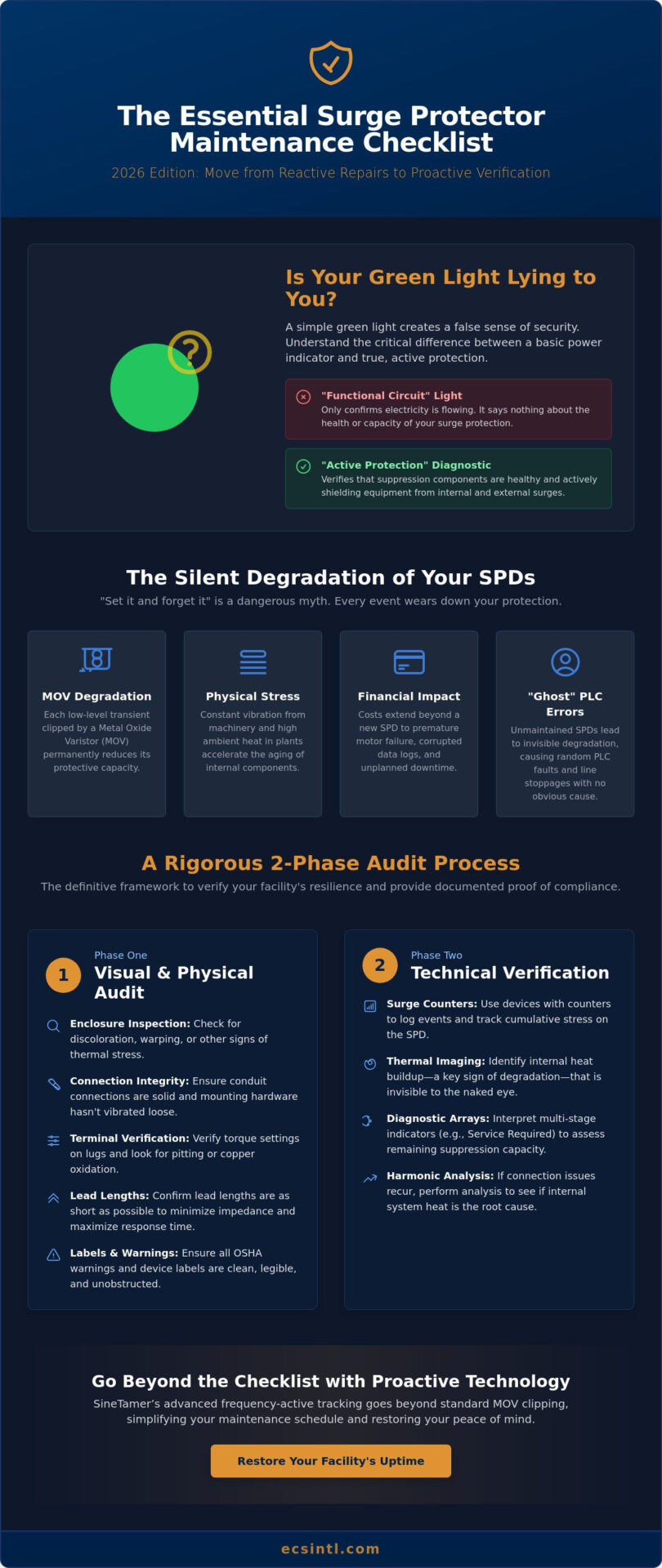
Maintenance isn’t a seasonal chore; it’s the proactive verification of suppression integrity. In 2026, the stakes are higher than ever. Utilizing a comprehensive surge protector maintenance checklist 2026 is the only way to move beyond guesswork. Most people think a green light means they’re safe. They’re wrong. A “functional circuit” just means electricity is flowing. “Active protection” means your equipment is actually shielded from the 80% of surges that originate inside your own walls. To understand the technical foundations, you might ask What is a Surge Protector? at its core. But in an industrial setting, it’s the difference between a smooth shift and a 3 AM emergency call.
We’ve all felt that sinking feeling when a PLC throws a “ghost” error. There’s no obvious cause, yet the line stops. This emotional toll is the direct result of unmaintained SPDs. These devices degrade silently, leaving your sensitive digital technology vulnerable to the increased grid volatility we’re seeing in 2026. You deserve better than invisible equipment degradation. You deserve a system that works as hard as you do.
Why “Set It and Forget It” is a Dangerous Industrial Myth
Metal Oxide Varistors (MOVs) aren’t invincible. Every low-level transient they clip eats away at their capacity. It’s a cumulative decline. Add in the constant vibration of heavy machinery and the rising ambient heat of a busy plant, and you have a recipe for premature aging. Following a strict surge protective device maintenance protocol is the only way to ensure your hardware remains within warranty and, more importantly, operational. Relying on a five-year-old installation without an audit is a gamble with your facility’s uptime.
The Financial Impact of Neglected Power Quality
Neglect carries a heavy price tag. It’s not just the cost of a new SPD. It’s the premature failure of expensive motors and the nightmare of corrupted data logs. When you implement a documented surge protector maintenance checklist 2026, you’re doing more than fixing wires. You’re restoring your own agency. You become the leader who prevents the catastrophe rather than the one scrambling to fix it. This proactive stance works hand-in-hand with your Uninterruptible Power Supply (UPS) strategy to create a wall of total uptime.
Phase 1: The Visual and Physical Integrity Audit
Visual inspection is your first line of defense. It’s the moment you step up and take control of your facility’s health. When you follow a surge protector maintenance checklist 2026, you’re looking for more than just dust. You’re looking for thermal stress. Discoloration on the enclosure or slight warping of the plastic tells a story of internal heat that your sensors might have missed. Check every conduit connection. Ensure mounting hardware hasn’t vibrated loose over months of heavy production. According to the NFPA 70B maintenance standard, keeping these physical components in top shape is essential for industrial safety. Don’t ignore the labels. If your OSHA warnings are faded or covered in oil, you’re risking more than just a fine; you’re risking clarity during a crisis.
Terminal and Connection Verification
Lead lengths matter. Shorter is always better. Every extra inch of wire adds impedance, which slows down the response time of your protection. Verify the torque settings on your mechanical lugs. Loose connections lead to arcing. Look for pitting or copper oxidation. These tiny scars are evidence of past battles and suggest the unit is nearing the end of its life. If you’re noticing recurring connection issues, professional harmonic analysis can help identify if internal system heat is the true culprit.
Indicator Light Logic: What “Green” Actually Means
That green LED is a comfort, but it’s not a guarantee. There is a massive difference between a “Power On” light and a “Protection Active” light. Advanced units feature multi-stage diagnostic arrays that tell you exactly how much suppression capacity remains. If you see a “Service Required” alarm, don’t wait. The peace of mind you deserve comes from knowing, not guessing. If your diagnostic array shows a partial failure, it means your equipment is currently standing in the line of fire without a full shield. Replace or service the unit immediately to restore your facility’s agency over its own uptime.
Phase 2: Technical Verification and Performance Tracking
Moving beyond the visual audit is where true reliability is forged. While a physical check catches obvious damage, technical verification reveals the silent erosion of your protection. Your surge protector maintenance checklist 2026 must include a review of internal surge counters. These logs tell you how many times your device has stood between a transient and your sensitive PLCs since your last audit. If the frequency is high, your device is likely suffering from performance degradation that a simple LED won’t show. You deserve a system that doesn’t just look okay but performs flawlessly under pressure.
Thermal scanning during peak load is another non-negotiable step. By identifying internal hotspots, you can catch failing components before they trigger a facility-wide shutdown. This proactive data gathering allows you to coordinate with a professional harmonic analysis. This ensures your SPD isn’t constantly fighting excessive electrical noise, which can lead to premature burnout. You aren’t just checking a box; you’re securing your professional status as a protector of uptime.
Diagnostic Testing Protocols
Reliable testing requires adhering to established IEEE SPD testing standards. Use a megohmmeter to test insulation resistance and check for leakage current to ground. These metrics shouldn’t be viewed in isolation. Document every result to establish a baseline. This history allows you to spot trends in degradation, giving you the agency to plan replacements during scheduled downtime rather than reacting to a midnight failure.
Grounding: The Foundation of Suppression
An SPD is only as effective as its path to ground. If that path is high-impedance, the surge has nowhere to go but through your equipment. Inspect upstream and downstream grounding paths for low-impedance continuity. Look for loose ground wires or corroded grounding rods that might have been neglected for years. Ground loops are another silent killer of sensitive electronics. They create circulating currents that confuse logic controllers and bypass even the best surge protection. Fixing these issues isn’t just about code compliance; it’s about restoring the stability of your entire technological landscape.
The 2026 Industrial Maintenance Frequency Checklist
Industrial environments operate under a different set of rules than residential neighborhoods. A once-a-year check before storm season simply won’t cut it when your production line’s heartbeat depends on clean power. To maintain true stability, you need a structured surge protector maintenance checklist 2026 that matches the intensity of your operations. This schedule isn’t just about technical compliance. It’s about protecting your quality of life by removing the constant threat of unexpected downtime. You deserve a work environment where technology is a silent partner, not a source of stress.
Establishing a rhythm of care is essential. Your quarterly tasks should focus on visual inspections and logging diagnostic LED statuses to catch early signs of stress. Every six months, move into deeper territory with physical connection checks and thermal imaging. Once a year, step back for a comprehensive site-wide power quality review to ensure your entire infrastructure remains resilient. Finally, never skip a post-event inspection. Any lightning strike or major utility outage demands an immediate look at your suppression integrity. This proactive approach ensures your surge protector maintenance checklist 2026 actually delivers on the promise of 100% uptime.
The Post-Event Protocol: Don’t Wait for Failure
A device that survives a major storm might look perfectly fine on the outside. However, it could be 90% depleted after absorbing a massive transient. Waiting for the indicator light to turn red is a gamble you don’t need to take. After any significant event, reset your digital counters and clear any fault codes. If the unit shows signs of distress or if the surge counter jumped significantly, it’s time for a factory-level technical analysis. You shouldn’t have to wonder if your protection is still there when the next strike hits.
Documentation and Compliance
Keeping a digital logbook does more than just organize your day. It provides documented proof of maintenance that can lead to insurance premium reductions. It also establishes clear accountability. When you own the power quality at your site, you move from being a reactive fixer to a proactive leader. This regular maintenance proves your value to the organization and ensures you remain the steady hand in a chaotic landscape. If you’re ready to secure your infrastructure and restore your personal agency, explore our industrial power quality solutions to see how we can support your goals.
Restoring Agency: Moving Beyond the Checklist with SineTamer
A checklist is a powerful tool, but it’s only as effective as the hardware it monitors. If you’re constantly replacing “disposable” units, you aren’t managing a facility; you’re managing a cycle of failure. Choosing the right hardware is the first step in any maintenance strategy. The SineTamer LA Series is engineered to reduce the burden on your surge protector maintenance checklist 2026 by providing superior durability. While standard devices rely on simple MOV clipping, SineTamer utilizes frequency-active tracking to filter out the small, repetitive transients that silently kill your electronics. This isn’t just a technical upgrade. It’s a promise of relief from the “ghost in the machine” errors we discussed earlier.
Your server room deserves the same level of attention. Integrating the SineTamer RM Series into your rack-mount maintenance flow ensures that your data infrastructure is just as resilient as your production line. When you choose hardware designed for longevity, your maintenance audits shift from a search for damage to a simple verification of stability. You gain back your time, your focus, and your professional standing.
The SineTamer Advantage: Built to Last
SineTamer’s thermal protection is a game-changer. It doesn’t just “blow” and leave your equipment vulnerable. It manages the thermal event safely, protecting the circuit while maintaining the integrity of the unit. This is why our users report significantly fewer “false positives” on their maintenance logs. You won’t spend your morning investigating alarms that shouldn’t be there. Instead, you’ll have the tranquility that comes from knowing your facility is battle-tested. We’ve spent decades perfecting this technology so you don’t have to worry about it.
Next Steps: Your Path to Total Stability
Don’t let legacy equipment dictate your stress levels. Upgrading your older units to SineTamer technology is the fastest way to simplify your maintenance requirements. It moves you away from the anxiety of invisible degradation and toward a state of total operational agency. We’re here to help you make that transition. You can start by requesting a professional site audit from Energy Control Systems. We’ll help you identify the weak points in your current infrastructure and provide a roadmap for restoration. Restore your operational agency today and finally experience the professional success you’ve worked so hard to achieve.
Take Command of Your Facility’s Future
Energy Control Systems is your partner in this journey. We bring 35+ years of power quality expertise and a global presence in 60+ countries to every installation. Our proprietary Frequency Attenuation Network technology is battle-tested to provide the relief you deserve. You don’t have to face the chaos of industrial power alone. It’s time to secure your infrastructure and reclaim your tranquility. We’re here to help you lead your organization with confidence and conviction. Success is within your reach, and we’re ready to help you protect it.
Download Our Comprehensive 2026 Maintenance Log & Restore Your Peace of Mind
Frequently Asked Questions
How often should I really check my industrial surge protectors?
You should perform a visual inspection quarterly and a technical audit every six months. High-stakes industrial environments can’t afford the “set it and forget it” mentality found in residential settings. If your facility experiences a major lightning strike or utility outage, inspect your units immediately. This proactive rhythm is the core of a reliable surge protector maintenance checklist 2026, ensuring your equipment never stands alone against a transient.
Can a surge protector still work if the indicator light is off?
No, if the “protection active” light is off, your equipment is likely vulnerable. While power might still flow through the circuit, the suppression components have probably sacrificed themselves to stop a previous surge. It’s a common point of confusion that leads to catastrophic downtime. You deserve the peace of mind that comes from a fully functional shield. Replace any unit showing a failed status light immediately to restore your protection.
What are the signs that an industrial SPD needs immediate replacement?
Look for physical signs like enclosure discoloration, warping, or a distinct “burnt” smell. Internal indicators like a “Service Required” alarm or a surge counter that has jumped significantly are also clear signals. These are the red flags that suggest your suppressor is nearing its end of life. Don’t wait for a total failure to act. Replacing a degraded unit now restores your agency and prevents an expensive midnight emergency.
Does a UPS replace the need for surge protector maintenance?
No, a UPS and an SPD serve different, complementary roles in your power quality strategy. While a UPS provides battery backup during outages, the SPD handles high-energy transients that can bypass or damage the UPS itself. Both systems require regular audits to ensure total uptime. Neglecting your surge protection while relying solely on a UPS leaves a dangerous gap in your facility’s armor and risks premature equipment failure.
How do I test an SPD without specialized equipment?
Without specialized tools, your testing is limited to visual inspections and reviewing built-in diagnostic arrays. You can check for physical integrity and log internal surge counts or alarm statuses. However, for a deep technical verification, you’ll eventually need thermal imaging or a megohmmeter. Including these steps in your surge protector maintenance checklist 2026 helps you identify hidden degradation before it leads to a “ghost in the machine” PLC error.
What is the lifespan of a SineTamer surge protector compared to standard units?
SineTamer units often last decades because they utilize frequency-active tracking rather than just standard MOV clipping. Standard units are often “disposable” and degrade with every small transient they encounter. SineTamer’s superior engineering manages these events without sacrificing the device’s integrity. This longevity reduces your long-term maintenance costs and provides a level of stability that standard, off-the-shelf protectors simply cannot match in a heavy industrial setting.
Can environmental heat affect the performance of my surge protection?
Yes, excessive heat is a silent enemy of electrical components. High ambient temperatures in a plant or internal heat from poor connections can accelerate the aging of suppression elements like MOVs. This is why thermal scanning is a critical part of a professional audit. By identifying hotspots early, you can address ventilation or connection issues before they trigger a premature failure of your protection system and disrupt your operations.
Why is lead length so critical during a maintenance check?
Lead length is critical because every extra inch of wire increases impedance. High impedance slows down the SPD’s response time, allowing a portion of the surge to reach your sensitive equipment before the protector can react. During your maintenance check, verify that leads are as short and straight as possible. This simple physical detail can be the difference between a protected PLC and a corrupted data log during a transient event.

Article by
Jeff Edwards
Founder of ECS International Inc. Edwards travels and speaks extensively in Latin America, Asia and Africa on the subject of power quality; transients and mitigating their impact on profitability. After graduating from Texas Tech University in Lubbock Texas, Edwards spent 9 years in the Telecommunications sector prior to founding Energy Control Systems in 1987 as a Texas based corporation selling surge suppression and UPS systems. The company has evolved into a global power quality products and energy efficiency concern with operations spanning South America, Asia, Europe and Africa.
Disclaimer
Some of the above information may be the opinion of the author.