

That heavy-duty surge protector at your main service entrance is often a dangerous illusion of safety. It’s a hard truth to swallow when you’re staring at a fried PLC on a perfectly clear afternoon. You’ve likely felt the exhaustion that comes with chasing “ghost” equipment failures and the crushing weight of production downtime costs. We understand that your job shouldn’t feel like a constant battle against invisible electrical chaos. Modern whole facility surge protection design requires more than a single device at the gate; it demands a cascaded defense that shields your most sensitive assets from both external strikes and internal noise.
You deserve the peace of mind that comes with a truly stable power environment. This guide will help you master the architecture of coordinated protection, from the main distribution board to the most delicate automation components. We’ll break down the 2026 NEC and IEC 61643-11 requirements so you can move past the confusion of Type 1, 2, and 3 devices. By the end, you’ll have a roadmap to reduce maintenance costs and extend equipment lifespan. It’s time to restore your operational agency and secure the professional recognition that comes with running a world-class, reliable facility.
Key Takeaways
- Stop relying on the “gatekeeper myth” and learn how a systemic approach filters out the electrical chaos that a single main panel device misses.
- Master the 3-tier cascaded defense strategy required for a robust whole facility surge protection design that safeguards your most sensitive automation.
- Identify the “silent killers” within your own walls, like ring wave transients from everyday switching, that cause more damage than lightning ever will.
- Uncover how proper grounding and bonding serve as the essential foundation for any successful power quality strategy.
- Follow a structured path from site analysis to implementation, helping you reclaim your time and earn recognition for improving plant reliability.
What is Whole Facility Surge Protection Design?
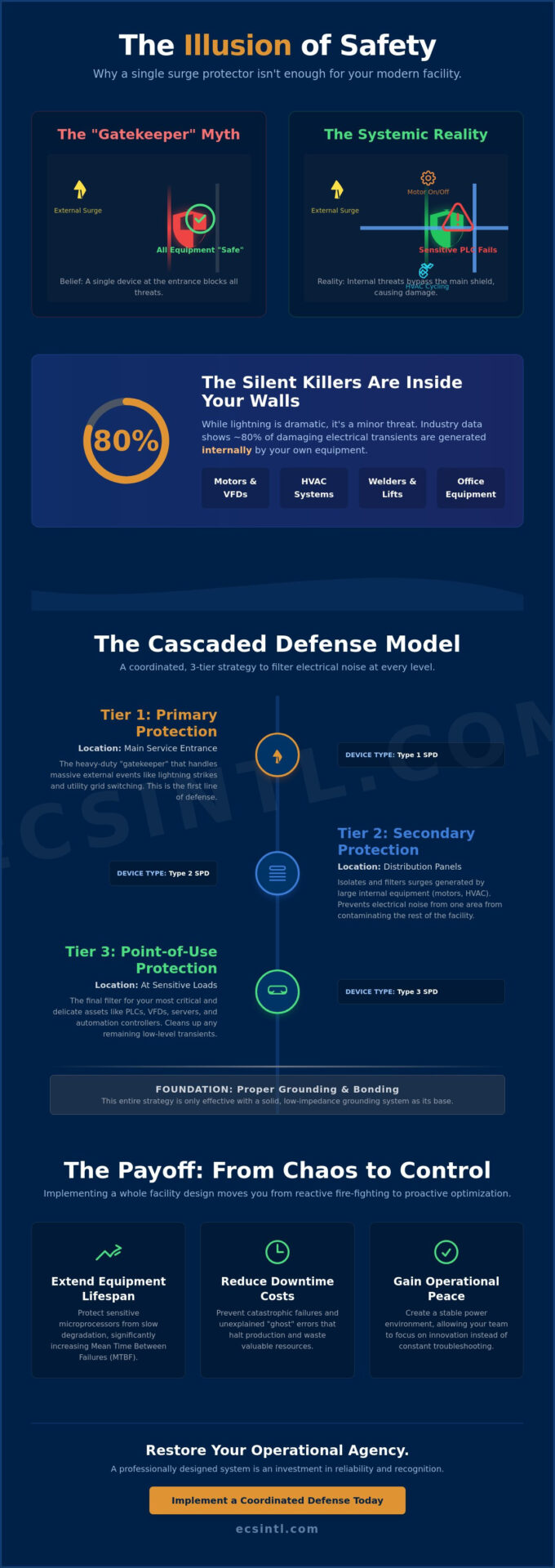
Most facility managers operate under a dangerous assumption. They believe that a heavy-duty surge suppressor at the main service entrance acts as an impenetrable shield for the entire plant. We call this the “gatekeeper” myth. In reality, relying on a single point of protection is like locking your front door while leaving every window wide open. True whole facility surge protection design isn’t about a single device; it’s a systemic, layered architecture that manages power quality at every level of your infrastructure.
Today’s industrial environment is more fragile than it was twenty years ago. Modern microprocessors are smaller, faster, and significantly more sensitive to voltage fluctuations. A minor electrical event that an old motor would have ignored can now brick a high-value PLC or disrupt a synchronized production line. You need a cascaded reality where protection is placed exactly where the risk lives. This is why we advocate for a “SineTamer” grade of protection; it’s designed specifically for these high-stakes environments where “good enough” usually ends in a costly failure.
The Limitations of Standard Surge Suppression
Standard surge arresters are built to handle catastrophic, external events like direct lightning strikes. While these are high-energy, they represent only a fraction of the threats your equipment faces. Industry data suggests that roughly 80% of electrical transients are generated from within your own building. A basic Surge protector at the service entrance cannot see or stop the internal “noise” created by your own elevators, HVAC units, or heavy motors. Transient voltage is a high-speed, high-energy event. Without a comprehensive whole facility surge protection design, these internal spikes travel freely through your electrical bus, slowly degrading sensitive components until they fail without warning.
The Economic Impact of Poor Design
What does a single hour of downtime actually cost your organization? When you factor in lost throughput, wasted raw materials, and emergency labor rates, the number is often staggering. Beyond the total failures, there’s the psychological toll of “ghost” errors. These are the unexplained resets and data corruptions that force your best technicians to spend hours chasing software bugs that are actually hardware power issues. It’s an exhausting cycle that drains your team’s morale and your company’s budget. By implementing a coordinated defense, you aren’t just buying hardware. You’re actively extending the Mean Time Between Failures (MTBF) for every asset on your floor. This leads to a “set and forget” environment where you can finally focus on optimization rather than constant fire-fighting.
The Cascaded Protection Model: A 3-Tier Defense Strategy
To achieve true operational stability, you must move beyond the single-device mindset. A robust whole facility surge protection design relies on a cascaded architecture. This isn’t just a recommendation; it’s a technical necessity defined by the IEEE C62.41 standard. This standard provides a blueprint for layering defenses so that high-energy external events and low-energy internal noise are both neutralized before they reach your sensitive electronics. Think of it as a series of filters. Each stage handles a specific type of electrical stress, ensuring that the energy reaching your PLC or controller is clean and safe.
- Step 1: Primary Protection (Type 1). Installed at the service entrance, these devices are your heavy lifters. They handle massive energy from lightning or utility switching.
- Step 2: Secondary Protection (Type 2). These are placed at distribution panels. Their job is to isolate the rest of the facility from surges generated by your own large motors or HVAC systems.
- Step 3: Point-of-Use Protection (Type 3). This is the final line of defense for your most delicate loads, such as rack-mounted servers or specialized laboratory equipment.
The secret to a successful design is coordination. Devices must work together without competing. If your Type 1 and Type 2 devices aren’t properly coordinated, the energy might “skip” a level, hitting your sensitive equipment with more voltage than it can handle. It’s about creating a path of least resistance for the surge energy to exit your system safely. If you’re unsure where your facility’s weakest link lies, a professional harmonic analysis can provide the clarity you need to move forward with confidence.
Service Entrance: The First Line of Defense
Your service entrance is where the outside world meets your infrastructure. Type 1 Surge Protective Devices (SPDs) must be rugged enough to survive the most violent external transients. While many look at kA ratings as the only metric of success, high energy capacity is only half the battle. You also need a low let-through voltage to ensure the surge is suppressed quickly. For infrastructure that cannot afford to fail, the SineTamer LA Series provides the industrial-grade durability required to keep the “gate” closed against utility instability.
Branch Panels and Critical Loads
Most of your daily headaches actually start inside your facility. Every time a large motor kicks on or a Variable Frequency Drive (VFD) cycles, it creates electrical noise that can confuse or damage nearby controllers. You must identify these “hotspots” and isolate them. For server rooms and critical data environments, the SineTamer RM Series is specifically engineered for rack-mount environments. It ensures that the “internal weather” of your plant doesn’t lead to a catastrophic data loss or an unexplained system crash.
The Silent Equipment Killer: Why Most Designs Fail Internal Transients
You aren’t safe just because the sky is clear. One of the most dangerous misconceptions in plant management is the belief that surge protection is only a “lightning season” concern. While a massive external strike is a visible threat, the real equipment killers are already inside your four walls. A comprehensive whole facility surge protection design must account for the silent, internal threats that occur thousands of times every day. These events don’t wait for a storm; they happen every time a motor cycles, an elevator moves, or an HVAC unit kicks on.
These internal events are known as “ring wave” transients. Unlike the singular “spike” of a lightning strike, ring waves are high-frequency oscillations caused by the daily switching of inductive loads. They are low in energy but high in frequency. Because they don’t always hit the high voltage thresholds required to trigger a standard surge protective device, they pass right through your defenses. This creates a cumulative degradation effect on your microprocessors. It’s electronic rust. Your equipment doesn’t die in a flash of light; it slowly wears down until a “random” failure brings your entire line to a screeching halt.
Frequency Attenuation vs. Voltage Clamping
Most standard SPDs are designed for “clamping.” They act like a pressure relief valve that only opens when the voltage hits a dangerously high level. This is fine for preventing a fire, but it’s useless against the high-frequency noise that crashes modern automation. High-frequency noise is the primary cause of industrial “glitches.” SineTamer utilizes frequency-tracking technology that doesn’t just wait for a voltage spike. It monitors the actual sine wave and filters out the destructive noise that standard devices miss. This level of precision is the difference between a system that merely survives and one that actually thrives. By addressing the frequency of the transient rather than just the height of the voltage, you eliminate the logic errors that lead to unexplained software “hangups.”
Protecting the ‘Brains’ of the Operation
Your SCADA systems and PLCs are the nervous system of your facility. They require more than just basic voltage suppression to stay healthy. They need a pristine electrical environment to process data accurately. We’ve seen facilities plagued by “random” resets and data corruption completely transform their uptime simply by adding SineTamer to their control circuits. There is a profound sense of relief that comes from knowing your automation won’t “blink” unexpectedly. When you invest in a whole facility surge protection design that prioritizes these sensitive controllers, you’re doing more than protecting hardware. You’re securing the data integrity and operational peace of mind that allows you to lead with confidence rather than constantly reacting to the next “ghost in the machine.”
Critical Design Considerations for Modern Industrial Plants
Modern industrial plants are masterpieces of engineering. They are also minefields of electrical instability. Designing for these environments requires more than just picking parts off a shelf. You need a strategy that acknowledges the unique stresses of heavy machinery and sensitive automation. A high-quality whole facility surge protection design is only as good as the foundation it’s built upon. If you ignore the environmental and systemic factors that drive power quality, even the best hardware will eventually fail you.
Variable Frequency Drives (VFDs) are a perfect example. While they are essential for energy efficiency, they are notorious for generating high-frequency noise that pollutes your electrical bus. This noise travels throughout your facility, threatening the very stability you worked so hard to build. Beyond the equipment itself, don’t overlook the basics like grounding and bonding. If your grounding system isn’t solid, surge energy has nowhere to go. It stays in your system, looking for a path to ground through your most expensive equipment. Harsh environments also demand rugged hardware; NEMA ratings for wash-down areas or outdoor locations aren’t optional. They are the armor that keeps your protection strategy intact.
Harmonics and Surge Protection: A Necessary Partnership
Harmonic distortion is a silent thief of equipment life. When your system is saturated with harmonics, your SPDs can overheat and fail prematurely. This creates a dangerous gap in your defenses that you might not notice until it’s too late. This is why a professional Harmonic Analysis is a non-negotiable step before finalizing your system design. It restores your agency by providing data-driven insights. You deserve to lead with facts, not assumptions, ensuring your protection system is tuned to the actual reality of your plant’s power profile.
Designing for UPS Integration
It’s a common mistake to assume an Uninterruptible Power Supply (UPS) is a surge protector. It isn’t. A UPS bridges the gap during a blackout, but its sensitive internal inverter is actually highly vulnerable to transients. Integrating Uninterruptible Power Supplies into a cascaded design ensures that the UPS itself survives to do its job. Protecting the “protector” is the hallmark of a mature whole facility surge protection design. It ensures total uptime and prevents the very device meant to save you from becoming another line item on a repair bill. To see how a coordinated design can stabilize your specific infrastructure, explore the custom solutions available at ECS International today.
Implementation: From Site Analysis to Operational Peace
Taking the first step toward a whole facility surge protection design is an act of professional leadership. It’s the moment you decide that “good enough” is no longer acceptable for your operation. You’ve seen the damage that internal noise and external strikes can do. Now, you need a structured path to move from a state of constant anxiety to one of total operational peace. This process begins with a rigorous site audit. You aren’t just looking for broken parts; you’re mapping the electrical vulnerabilities of your entire infrastructure.
A successful implementation requires a specialized technical partner rather than a general electrical contractor. While a generalist focuses on meeting basic safety codes, a power quality specialist understands the nuanced behavior of high-frequency transients. They look for the “noisy” loads like VFDs and large motors that we’ve identified as the primary internal threats. This partnership ensures that your investment is targeted where it will provide the most relief. Once installed, long-term maintenance is simple. High-quality systems include visual indicators and surge counters. These tools provide tangible proof of the protection you’ve implemented, turning the invisible work of power quality into visible data that confirms your system is safe.
Selecting the Right SineTamer Series
A one-size-fits-all approach has no place in a professional whole facility surge protection design. You must match the protection to the specific load. Use the SineTamer LA Series at your service entrance to handle the raw energy of the outside world. For your data centers and sensitive server racks, the SineTamer RM Series provides the specialized filtering required for high-speed microprocessors. When it comes to the specialized machinery on your production floor, the ST Series offers the ruggedized defense needed for individual sub-panels. This is the “SineTamer Advantage.” Using battle-tested hardware in a global market empowers you to become the hero of uptime within your organization.
Your Path to Stability
Your journey from “fighting fires” to proactive management is just one step away. The transition begins when you stop reacting to failures and start preventing them. You deserve a work environment where “ghost” errors and unexplained resets are things of the past. By requesting a professional site analysis from ECS experts, you gain a partner dedicated to your personal and professional success. We provide the data-driven insights you need to secure your facility and your reputation. Contact ECS today for a customized whole facility surge protection design and finally experience the tranquility of a truly stable power environment.
Take Command of Your Power Quality Environment
You’ve seen the high cost of waiting for the next “random” failure. True stability starts with shifting your perspective from simple surge suppression to a cascaded, systemic defense. By addressing both external strikes and the silent, high-frequency noise generated within your walls, you protect the microprocessors that drive your automation. Implementing a robust whole facility surge protection design isn’t just about hardware; it’s about restoring your agency as a leader in plant reliability. It’s about ensuring that your team spends their hours on optimization rather than emergency repairs.
At ECS, we bring over 30 years of global power quality expertise to your facility. Our proprietary frequency-tracking technology and dedicated industrial harmonic analysis services ensure that your protection is precisely tuned to your unique electrical environment. It’s time to move past the exhaustion of unexplained downtime and embrace a “set and forget” power strategy that earns you the respect you deserve.
Secure your facility’s future with a custom SineTamer design from ECS. You have the power to transform your plant into a beacon of reliability. We’re here to provide the steady hand and technical expertise you need to make it happen. Your path to operational peace of mind starts today.
Frequently Asked Questions
What is the difference between a surge arrester and a surge protective device (SPD) in facility design?
Surge arresters are heavy-duty devices meant for high-voltage distribution and utility lines to prevent catastrophic fires. Surge protective devices (SPDs) are engineered for the lower voltage levels found inside your facility to protect sensitive microprocessors. While an arrester stops the building from burning down, an SPD ensures your automation keeps running. You need both to achieve total operational stability.
Can one large surge protector at the main panel protect my entire factory?
A single main panel protector leaves your distant equipment vulnerable to the 80% of surges that are generated internally. Electrical noise and transients created by your own motors, elevators, or HVAC units occur downstream of the main panel. Relying on one device ignores the internal “weather” of your plant and fails to address the “gatekeeper” myth that leads to unexplained equipment failure.
How do internally generated surges damage my PLCs and sensitive electronics?
Internally generated surges cause cumulative degradation of sensitive microprocessors through a process often called “electronic rust.” Every time a large inductive load cycles, it sends a small transient through your electrical bus. These events are often too small to trip a standard breaker. However, they’re strong enough to slowly destroy the delicate pathways inside your PLCs until they fail without warning.
What is a cascaded surge protection design and why is it recommended by IEEE?
A cascaded surge protection design is a tiered defense strategy that places specific protectors at different points in your electrical system. The IEEE recommends this approach because it ensures that high-energy surges are handled at the service entrance while lower energy noise is filtered at the distribution and branch levels. It creates a coordinated, low-resistance path for surge energy to exit your system safely.
How often should I replace the surge protection devices in my facility?
You should replace your SPDs based on their actual exposure to surge events rather than a set calendar date. Most modern industrial units include visual indicators or surge counters that tell you when the internal components are depleted. We recommend checking these indicators during your monthly maintenance rounds. This simple habit ensures your protective shield remains intact and your facility stays stable.
Does a UPS provide enough surge protection for my industrial equipment?
A UPS is designed for power continuity during a blackout, but it’s not a substitute for high-quality surge protection. In fact, the sensitive inverters inside a UPS are often the first things to fail during a major transient event. You must protect the UPS itself with a coordinated whole facility surge protection design to ensure it survives to bridge the next power gap when you need it most.
What are ring wave transients and why are they dangerous for automation?
Ring wave transients are high-frequency oscillations caused by the rapid switching of electrical loads within your facility. They don’t have the brute force of lightning, but their high frequency causes the “logic errors” and unexplained resets that plague automation. They’re dangerous because they pass right through standard clamping devices that only look for high-voltage spikes, leaving your controllers exposed.
How does harmonic distortion affect the performance of my surge protectors?
Harmonic distortion creates extra heat that can lead to the premature failure of your surge protective devices. When your electrical system is saturated with harmonics, the SPD’s internal components work harder than they were designed to, which shortens their lifespan. This is why we recommend a whole facility surge protection design that includes a harmonic analysis to ensure your hardware is properly matched to your power profile.

Article by
Jeff Edwards
Founder of ECS International Inc. Edwards travels and speaks extensively in Latin America, Asia and Africa on the subject of power quality; transients and mitigating their impact on profitability. After graduating from Texas Tech University in Lubbock Texas, Edwards spent 9 years in the Telecommunications sector prior to founding Energy Control Systems in 1987 as a Texas based corporation selling surge suppression and UPS systems. The company has evolved into a global power quality products and energy efficiency concern with operations spanning South America, Asia, Europe and Africa.
Disclaimer
Some of the above information may be the opinion of the author.