

What if your primary electrical defense was looking the wrong way? You likely invested in a high quality surge protector at your service entrance to shield your facility from the outside world, yet the problems persist. It is a psychological burden to manage a facility where unexplained PLC resets and VFD failures continue to halt production without warning. We understand that frustration. You deserve a work environment defined by stability rather than constant technical anxiety.
We agree that your peace of mind should not be at the mercy of internal electrical noise. This guide will show you why surge protection for subpanels is the missing link in your defense strategy. You will discover how to stop internal transients from destroying your sensitive electronics and learn the “Zone of Protection” concept that seasoned experts use to achieve total operational tranquility. We will also touch on how the latest industry standards now reinforce this cascaded approach to safeguard your professional success.
Key Takeaways
- Stop the “Distance Rule” from undermining your main panel defense by understanding why surges can reform downstream.
- Identify the “Electronic Rust” caused by internal transients that slowly destroys your sensitive VFDs and PLCs from within.
- Implement surge protection for subpanels to create a cascaded defense system that aligns with industry-standard IEEE C62.41 recommendations.
- Learn how optimizing lead length during installation ensures your protective hardware actually stops transients before they reach critical loads.
- Achieve operational tranquility by transforming your facility from a high-stakes environment into a stable, protected landscape.
The Hidden Vulnerability: Why Main Panel Surge Protection Isn’t Enough
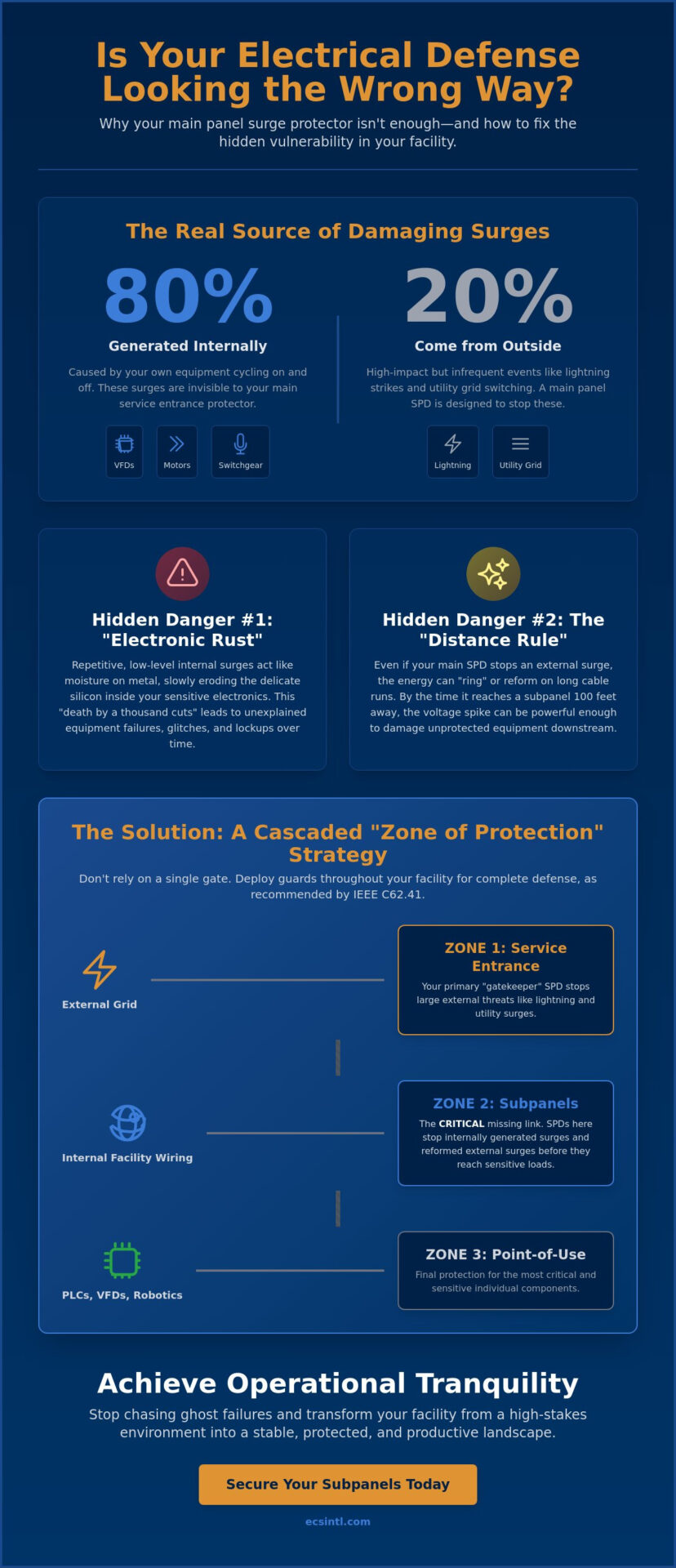
You have done what the experts suggested. You invested in high-quality units at your service entrance to shield your facility from the outside world. Yet, the problems persist. Your PLCs are still rebooting at random. Your VFDs are still throwing cryptic codes that halt production. It feels like a betrayal of your investment. This happens because a single line of defense is rarely enough in a complex industrial environment. Think of your facility as a fortress with a massive iron gate but no guards in the hallways. A Surge protector at the main panel is your gatekeeper, but it cannot stop the threats already lurking inside your halls. This is why surge protection for subpanels is the critical second layer of a cascaded defense system.
There is a technical reality often overlooked called the “Distance Rule.” Even when your main SPD successfully clamps a massive external surge from the grid, the energy can reform or “ring” as it travels down long cable runs toward your subpanels. By the time that power reaches your sensitive machinery, the voltage spike has effectively resurrected. It is a silent, invisible vulnerability that bypasses your primary shield. To achieve true stability, you must address both external lightning strikes and the internal chaos generated by your own equipment.
The 80/20 Rule of Electrical Transients
Most facility managers stay awake worrying about lightning or utility switching. These are high-impact external threats, but they are not your daily enemy. Industry data reveals that 80% of transients are actually generated inside your own four walls. Every time a large motor cycles off or a piece of heavy switchgear operates, it creates a localized spike. Because these events originate downstream, your main panel SPD never even sees them. They hit your subpanel and then go straight into your most expensive digital technology. Without surge protection for subpanels, your sensitive electronics are forced to absorb these shocks every single day.
Why Subpanels are the ‘Soft Underbelly’ of Your Factory
Your subpanels are the last stop before power reaches your PLCs, sensors, and robotics. This proximity makes them the “soft underbelly” of your infrastructure. You might assume your standard circuit breakers offer protection, but they are designed to stop sustained overcurrent, not transient events. A breaker takes milliseconds to trip. A transient event happens in nanoseconds. The damage is done before the breaker even begins to move. When you secure these points, you finally stop the recurring “glitches” that haunt your production schedule. It is about more than just hardware. It is about restoring your personal agency and ensuring you don’t spend your weekends chasing ghost failures in the system.
Internal Transients: The Silent Killer Lurking in Your Subpanels
Lightning is the spectacle everyone fears, but internal transients are the true saboteurs of your productivity. These low-level voltage spikes are born from inductive load switching, occurring every time a motor cycles or a relay clicks. They don’t typically cause a “Big Bang” that melts a panel in an instant. Instead, they inflict a “Death by a Thousand Cuts.” This phenomenon is often called “Electronic Rust.” Just as moisture slowly eats away at steel, these repetitive micro-surges erode the delicate silicon layers inside your microprocessors and sensitive electronics. Over time, your components become brittle, leading to those “unexplained” failures that keep you at the plant long after your shift should have ended.
We believe you deserve better than a life spent chasing ghost errors. Our team acts as a seasoned protector, using tools like harmonic analysis to make the invisible visible. By adhering to established industry standards for surge protection, we help you identify the specific points where your power quality is failing. It’s about moving beyond guesswork and reclaiming your personal agency over your facility’s health.
Common Sources of Subpanel Surges
Your own equipment is often the source of its own demise. Variable Frequency Drives (VFDs) are notorious for creating high-frequency electrical noise that pollutes the local subpanel. While VFDs are essential for modern efficiency, they are also aggressive surge generators. Similarly, the massive inductive kick from large AC units requires a specific hvac surge protector strategy to prevent damage to nearby controllers. Even the simple arcing from contactors and relays can disrupt sensitive communication lines, causing data corruption that halts an entire assembly line. Installing surge protection for subpanels at these critical junctions stops the noise at the source before it can spread through your system.
The Cost of Inaction: Beyond the Repair Bill
The price of a replacement part is only the tip of the iceberg. The real damage lies in the hidden costs: the lost data that takes hours to recover, the ruined batches of product that must be scrapped, and the mounting technician overtime. Beyond the balance sheet, there is a human cost. Frequent downtime erodes your status within the organization and creates a constant state of technical anxiety. Achieving operational tranquility means more than just saving hardware; it means restoring your peace of mind. If you’re ready to stop the silent erosion of your hardware, exploring comprehensive power quality solutions is the first step toward reclaiming your facility’s stability.
The Cascaded Protection Strategy: Securing Subpanels and Point-of-Use
Relying on a single surge protector at your service entrance is like hoping one umbrella will keep an entire crowd dry during a downpour. It simply isn’t enough. To achieve true operational tranquility, you must move beyond a single point of failure. This is where the cascaded protection strategy becomes your most powerful ally. It is a multi-layered approach designed to catch what the main panel misses. By following the IEEE Guide for Application of SPDs, you can transform your facility from a chaotic electrical environment into a structured zone of safety. We understand the weight of responsibility you carry; the pressure to maintain 100% uptime is immense. Cascading is the roadmap that leads you there.
In most industrial power quality plans, surge protection for subpanels is the missing link. You might have the service entrance covered, but the internal pathways remain exposed. The “Zone” concept allows you to isolate noisy loads, like large motors or compressors, from your sensitive electronics. This ensures that a transient created in one corner of your plant doesn’t travel through the wiring to destroy a controller in another. It is about creating boundaries that protect your most valuable assets from the daily electrical noise that otherwise erodes their lifespan.
How Cascading Works to Restore Order
The IEEE C62.41 standard categorizes environments to help you deploy the right strength of protection where it matters most. Category C is your service entrance. This is where you face the brute force of the external world, such as lightning or utility switching. Your main SPD acts as the heavy lifter here. Category B covers your subpanels. This is the critical middle ground where surge protection for subpanels cleans up residual voltage and stops internal transients from spreading. Finally, Category A focuses on point-of-use protection. This provides the final, delicate shield for your most critical scada systems and instrumentation. Each layer works in harmony to reduce the let-through voltage to a level your electronics can actually handle.
Designing Your Defense Perimeter
You don’t need to protect every single outlet, but you must protect the heartbeat of your operation. Start by identifying which subpanels feed your most critical production lines. Prioritize panels that house a mix of heavy motors and sensitive controls, as these are the areas where the electrical “civil war” is most intense. Cascaded protection is the industry standard for achieving 99.9% uptime. By implementing this perimeter, you are not just buying hardware; you are investing in a future free from the stress of unexplained failures. You are reclaiming your personal agency and ensuring your facility remains a source of stability rather than a source of constant frustration.
Selecting the Right SPD for Industrial Subpanels
Choosing the wrong hardware is a recipe for continued frustration. You might think any box with a high “kA” rating will do the job, but industrial environments are far more demanding than residential ones. Standard surge arresters are like blunt instruments. They are designed to stop massive, catastrophic hits, but they often ignore the high-frequency noise and ring waves that bypass standard MOVs. We understand that you don’t just want a device; you want the relief of knowing your system is actually stable. Selecting the right surge protection for subpanels requires looking beyond the glossy marketing stickers and focusing on the engineering that actually protects your silicon.
Lead length is the silent saboteur of even the best installations. In the world of transients, every inch of wire adds inductance. This impedance slows down the response time of the SPD. If your leads are too long, the surge will reach your sensitive PLC before the protector even begins to work. Shorter is always better. To achieve true operational tranquility, your installation must be as tight and direct as possible. This technical nuance is often the difference between a protected line and another midnight service call.
Why SineTamer LA Series Outperforms Standard SPDs
Most off-the-shelf SPDs only react when the voltage hits a specific, high threshold. By then, the “Electronic Rust” we discussed earlier has already done its damage. The SineTamer LA Series utilizes advanced frequency attenuation and tracking filters that follow the sine wave. It doesn’t just wait for a massive spike; it cleans up the high-frequency noise that standard devices miss. This is the technology required to stop “ghost” errors in their tracks. It’s about protecting your digital technology in harsh industrial climates where standard equipment fails. When you install an LA Series unit, you aren’t just adding a component. You are restoring your personal agency and ensuring your facility remains a source of professional pride.
Key Specifications to Look For
Don’t be distracted by kA ratings. While a high kA rating sounds impressive, let-through voltage is the only stat that truly matters for your equipment’s survival. This number tells you exactly how much damaging energy actually reaches your sensitive loads. Additionally, look for diagnostic monitoring features like LEDs and dry contacts. These tools empower your maintenance team to verify protection status at a glance. Before you order, always verify your specific voltage configurations, whether you are running 120/208V or 277/480V systems. Getting these details right ensures that your defense perimeter is impenetrable.
If you are tired of unexplained downtime and want to secure your facility once and for all, contact our team of experts to find the perfect protection strategy for your specific subpanel layout.
Eliminating Downtime: Moving Toward Total Operational Tranquility
You have lived through the stress of the “unexplained” failure for too long. The journey from electrical chaos to a stabilized facility is more than a technical upgrade. It’s a restoration of your personal agency. By implementing surge protection for subpanels, you stop being the person who merely reacts to breaks and start being the person who prevents them. We understand that this isn’t just about hardware. It’s about your right to a stress-free environment where your equipment actually does what it’s supposed to do. You deserve to walk into your facility every morning with a sense of calm, knowing your defense perimeter is secure.
We’ve discussed the “Electronic Rust” that eats your silicon and the “Distance Rule” that bypasses your main panel. Now, it’s time to act on that knowledge. Moving toward total operational tranquility means closing the gaps that let transients through. It’s a shift from a state of technical anxiety to one of absolute certainty. When you secure your subpanels, you aren’t just buying insurance. You’re investing in the steady, reliable rhythm of a facility that stays online.
The Path to Professional Success
When the “ghost” errors stop and the PLCs stop resetting, people notice. Your reputation within the organization changes. You move from a reactive firefighter to a proactive technical leader who commands respect. Stability is a choice. While securing your subpanels is a massive leap forward, don’t forget the hubs of your data network. The SineTamer RM Series is the logical next step for your server racks. It ensures that your communication hubs are just as protected as your production floor, providing a complete blanket of safety for your digital assets.
Taking the First Step Toward Relief
You don’t have to guess where your vulnerabilities are. ECS acts as your seasoned protector, partnering with you for site-specific analysis and custom solution design. We use tools like harmonic analysis to find the silent killers in your power quality that standard meters miss. This isn’t a one-size-fits-all transaction; it’s an ongoing dialogue focused on your success. We help you review your layout and identify the specific vulnerability gaps where surge protection for subpanels will provide the most immediate relief.
Hope is not a strategy for power quality. It’s time to move beyond wishing for a stable grid and start creating one within your own walls. Reclaim your time and your status as a leader in your organization. Request a Quote for SineTamer Subpanel Protection today and begin your journey toward the operational tranquility you’ve earned.
Reclaim Your Operational Tranquility and Professional Status
We have explored how internal transients act as “Electronic Rust” and why your main panel SPD is blind to the electrical chaos generated inside your own four walls. True stability requires a layered defense that stops transients where they originate. Implementing surge protection for subpanels is the only way to ensure your sensitive PLCs and VFDs are shielded from the daily switching events that otherwise erode their lifespan. You’ve worked too hard to let invisible power quality issues undermine your success.
You shouldn’t have to spend your weekends chasing ghost failures or explaining away production delays. With over 30 years of industrial power quality expertise, we provide SineTamer technology, the world’s most effective surge suppression solution. Our global distribution and technical support teams are ready to help you move from a state of technical anxiety to one of absolute certainty. It’s time to restore your personal agency and ensure your facility remains a source of professional pride and operational stability.
Stop the silent killers in your subpanels—get a SineTamer quote today. Your journey toward a stabilized, protected environment starts with a single proactive step. We are here to help you achieve the peace of mind you deserve.
Frequently Asked Questions
Does a main panel surge protector protect subpanels?
A main panel SPD provides a first line of defense, but it cannot fully protect your subpanels from internal threats. While it clamps massive external surges, energy can reform as it travels down long cable runs. Additionally, 80% of damaging transients originate inside your facility. These internal spikes never reach the main panel, leaving your downstream electronics exposed. Dedicated surge protection for subpanels is the only way to bridge this vulnerability gap.
Can I install a whole-house surge protector in a subpanel?
You can install a whole-house unit, but it is rarely the right tool for industrial subpanels. Residential-grade devices are designed for standard household appliances, not the aggressive electrical noise of a factory floor. Industrial subpanels require advanced suppression technology that handles both high-energy hits and the constant micro-transients that erode sensitive PLCs. Using a professional-grade suppressor ensures your high-stakes equipment remains operational without the constant threat of “ghost” errors.
What is the difference between a surge arrester and a surge suppressor for subpanels?
Surge arresters and surge suppressors serve very different roles in your power quality strategy. An arrester is a blunt instrument designed to stop catastrophic voltage spikes from lightning. In contrast, a high-quality suppressor tracks the sine wave to clean up the low-level noise and high-frequency transients. For industrial subpanels, you need a suppressor that stops the “Electronic Rust” caused by repetitive micro-surges, rather than just waiting for a once-in-a-decade lightning strike.
How many surge protectors do I need for multiple subpanels?
You generally need one dedicated SPD for every subpanel that feeds critical or sensitive loads. Installing surge protection for subpanels at each distribution point prevents electrical noise from one area of the plant from polluting another. This cascaded approach creates a series of defense zones. It ensures that even if a transient is generated by a large motor on one line, it is stopped before it can travel to your server racks or controllers.
Will a subpanel SPD stop electrical noise from a VFD?
A high-quality subpanel SPD with frequency attenuation will stop VFD noise, but a standard MOV-based unit will not. Variable Frequency Drives create aggressive high-frequency electrical pollution that bypasses basic surge protectors. You need advanced technology, like the SineTamer LA Series, which is specifically engineered to track the sine wave and filter out this noise. This protection is vital for restoring stability to your communication lines and sensitive digital sensors.
What happens if the lead length on my subpanel SPD is too long?
Excessive lead length creates inductance that significantly slows down the response time of your protector. In a transient event, every nanosecond counts. If your leads are too long, the voltage spike will reach your sensitive electronics before the SPD can activate. We recommend keeping lead lengths as short and straight as possible. This ensures the hardware you invested in can actually do its job and provide the relief you expect.
Is it necessary to protect subpanels if they are in the same building as the main panel?
Yes, subpanel protection is essential even if the panels are located in the same building. Physical proximity to the main panel does not shield your equipment from the internal transients generated by your own machinery. Motors, HVAC units, and heavy switchgear create localized spikes that hit the subpanel first. Without localized protection, your sensitive electronics remain vulnerable to these daily shocks, regardless of how close they are to the main service entrance.
How do I know if my subpanel needs a Type 1 or Type 2 SPD?
Most subpanels require a Type 2 SPD, as they are located on the load side of the main service disconnect. Type 1 SPDs are typically installed at the service entrance to handle external surges from the grid. According to the 2026 NEC, specific locations like first responder sleeping quarters now mandate these protections at the subpanel level. We recommend consulting with a technical expert to verify your specific configuration and ensure your installation meets local safety codes.

Article by
Jeff Edwards
Founder of ECS International Inc. Edwards travels and speaks extensively in Latin America, Asia and Africa on the subject of power quality; transients and mitigating their impact on profitability. After graduating from Texas Tech University in Lubbock Texas, Edwards spent 9 years in the Telecommunications sector prior to founding Energy Control Systems in 1987 as a Texas based corporation selling surge suppression and UPS systems. The company has evolved into a global power quality products and energy efficiency concern with operations spanning South America, Asia, Europe and Africa.
Disclaimer
Some of the above information may be the opinion of the author.